



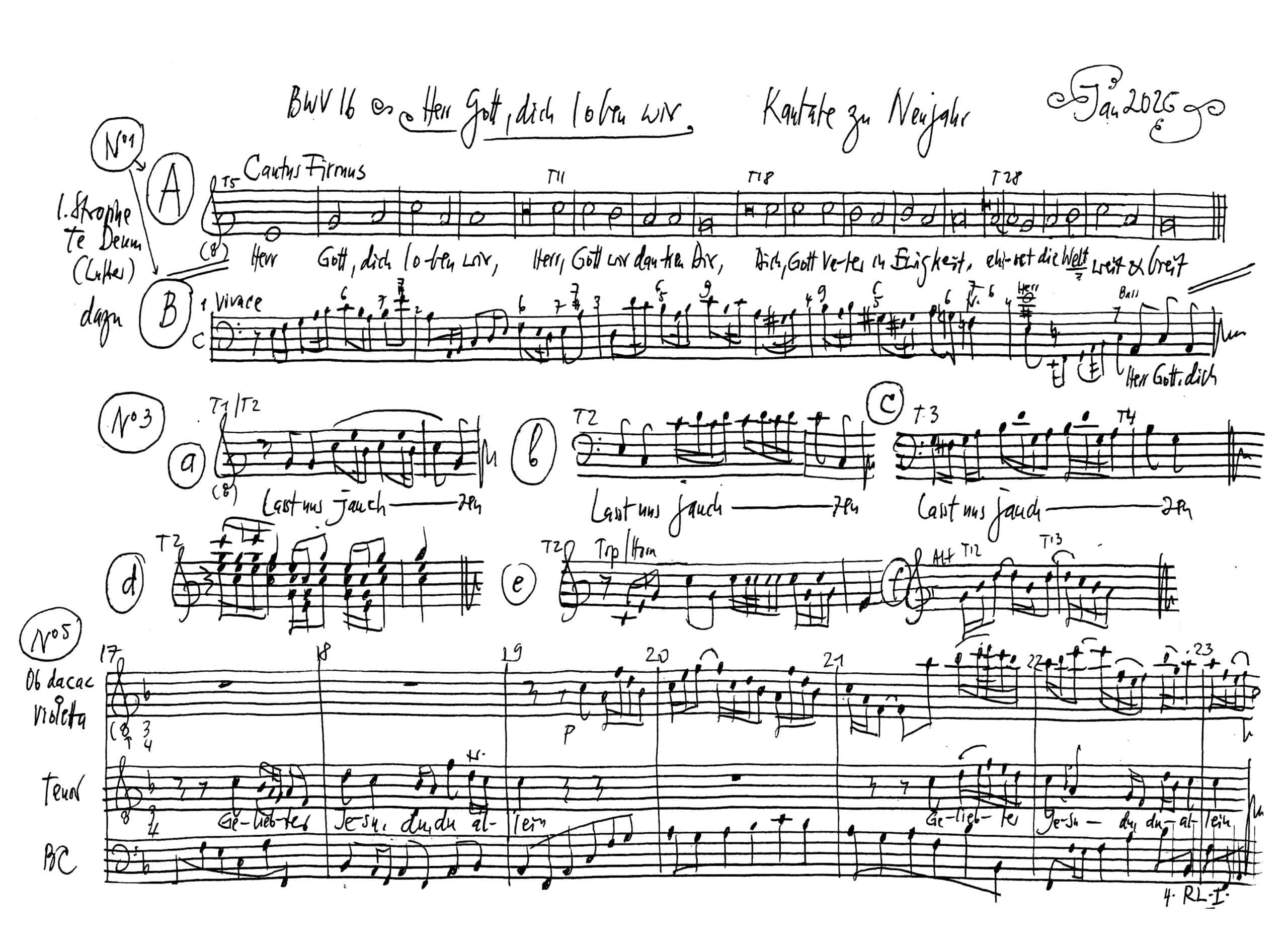
Herr Gott, dich loben wir
BWV 016 // For New Year's Day (Feast of the Circumcision)
(Lord God, we give thee praise) for alto, tenor and bass, vocal ensemble, oboe I+II and oboe da caccia, corno da caccia, strings and basso continuo

Place of composition in the church year



Pericopes for Sunday
Pericopes are the biblical readings for each Sunday and feast day of the liturgical year, for which J. S. Bach composed cantatas. More information on pericopes. Further information on lectionaries.
Ich will den Herrn loben allezeit; sein Lob soll immerdar in meinem Munde sein. Meine Seele soll sich rühmen des Herrn, dass es die Elenden hören und sich freuen. Preiset mit mir den Herrn und lasst uns miteinander seinen Namen erhöhen.
Ehe denn aber der Glaube kam, wurden wir unter dem Gesetz verwahrt und verschlossen auf den Glauben, der da sollte offenbart werden. Also ist das Gesetz unser Zuchtmeister gewesen auf Christum, dass wir durch den Glauben gerecht würden. Nun aber der Glaube gekommen ist, sind wir nicht mehr unter dem Zuchtmeister. Denn siehe auch unter Ratswechsel ihr seid alle Gottes Kinder durch den Glauben an Christum Jesum. Denn wie viel euer auf Christum getauft sind, die haben Christum angezogen. Hier ist kein Jude noch Grieche, hier ist kein Knecht noch Freier, hier ist kein Mann noch Weib; denn ihr seid allzumal einer in Christo Jesu. Seid ihr aber Christi, so seid ihr ja Abrahams Same und nach der Verheissung Erben.
Und da acht Tage um waren, dass das Kind beschnitten würde, da ward sein Name genannt Jesus, welcher genannt war von dem Engel, ehe denn er im Mutterleibe empfangen ward.
Choir
Soprano
Lia Andres, Noëmi Sohn Nad, Simone Schwark, Susanne Seitter, Noëmi Tran-Rediger, Mirjam Wernli
Alto
Anne Bierwirth, Antonia Frey, Alexandra Rawohl, Jan Thomer, Lisa Weiss
Tenor
Clemens Flämig, Zacharie Fogal, Christian Rathgeber, Sören Richter
Bass
Jean-Christophe Groffe, Fabrice Hayoz, Serafin Heusser, Israel Martins, Simón Millán
Orchestra
Conductor
Rudolf Lutz
Violin
Renate Steinmann, Monika Baer, Patricia Do, Elisabeth Kohler Gomes, Olivia Schenkel, Salome Zimmermann
Viola
Susanna Hefti, Claire Foltzer, Matthias Jäggi
Violoncello
Martin Zeller, Hristo Kouzmanov
Violone
Markus Bernhard
Oboe
Andreas Helm, Thomas Meraner
Bassoon
Susann Landert
Contrabassoon
Ester van der Veen
Horn
Stephan Katte
Harpsichord
Thomas Leininger
Organ
Nicola Cumer
Musical director & conductor
Rudolf Lutz
Workshop
Participants
Rudolf Lutz, Pfr. Niklaus Peter
Reflective lecture
Speaker
Florian Werner
Recording & editing
Recording date
23/01/2026
Recording location
Trogen AR (Switzerland) // Protestant Church
Sound engineer
Stefan Ritzenthaler
Producer
Meinrad Keel
Executive producer
Johannes Widmer
Production
GALLUS MEDIA AG, Schweiz
Producer
J.S. Bach-Stiftung, St. Gallen, Schweiz
Librettist
First performance
1 January 1726 in Leipzig
Poet unknown
Movement 1: Martin Luther, 1529
Movements 2–5: Georg Christian Lehms, 1711
Movement 6: Paul Eber, around 1570
Libretto
1. Chor
Herr Gott, dich loben wir,
Herr Gott, wir danken dir.
Dich, Gott Vater in Ewigkeit,
ehret die Welt weit und breit.
2. Rezitativ — Bass
So stimmen wir
bei dieser frohen Zeit
mit heißer Andacht an
und legen dir,
o Gott, auf dieses neue Jahr
das erste Herzensopfer dar.
Was hast du nicht von Ewigkeit
vor Heil an uns getan,
und was muß unsre Brust
noch jetzt vor Lieb und Treu verspüren!
Dein Zion sieht vollkommne Ruh,
es fällt ihm Glück und Segen zu;
der Tempel schallt
von Psaltern und von Harfen,
und unsre Seele wallt,
wenn wir nur Andachtsglut in Herz und Munde führen.
O, sollte darum nicht
ein neues Lied erklingen
und wir in heißer Liebe singen?
3. Aria tutti — Chor und Bass
Chor
Laßt uns jauchzen, laßt uns freuen:
Gottes Güt und Treu
bleibet alle Morgen neu.
Bass
Krönt und segnet seine Hand,
ach so glaubt, daß unser Stand
ewig, ewig glücklich sei.
4. Rezitativ — Alt
Ach treuer Hort,
beschütz auch fernerhin dein wertes Wort,
beschütze Kirch und Schule,
so wird dein Reich vermehrt,
und Satans arge List gestört;
erhalte nur den Frieden
und die beliebte Ruh,
so ist uns schon genug beschieden,
und uns fällt lauter Wohlsein zu.
Ach! Gott, du wirst das Land
noch ferner wässern,
du wirst es stets verbessern,
du wirst es selbst mit deiner Hand
und deinem Segen bauen.
Wohl uns, wenn wir
dir für und für,
mein Jesus und mein Heil, vertrauen.
5. Arie — Tenor
Geliebter Jesu, du allein
sollst unser Seelen Reichtum sein.
Wir wollen dich vor allen Schätzen
in unser treues Herze setzen,
ja, wenn das Lebensband zerreißt,
stimmt unser gottvergnügter Geist
noch mit den Lippen sehnlich ein:
Geliebter Jesu, du allein
sollst unser Seelen Reichtum sein.
6. Choral
All solch dein Güt wir preisen,
Vater ins Himmels Thron,
die du uns tust beweisen
durch Christum, deinen Sohn,
und bitten ferner dich,
gib uns ein friedlich Jahre,
vor allem Leid bewahre
und nähr uns mildiglich.
This text has been translated with DeepL (www.deepl.com).
Florian Werner
Have you praised today?
On Cantata BWV 16: ‘Lord God, we praise you’
A paw. The clawed paw of a bear. It hovers in the air, ready to strike, right next to the head of a little boy. He grins. Apparently, he has no idea of the danger threatening his cheek. He clearly knows nothing of the violent blow he is about to receive, which cannot adequately be described as a “slap in the face”. He is probably unaware of any danger or even guilt; perhaps he is even expecting encouragement — because beneath him and the paw is the question: “Have you praised your child today?”
That’s the first thing that comes to mind when I hear the word “praise”. It’s a sticker that was displayed on the tailgate of a neighbour’s car during my childhood, right next to the sticker with the stylised cannabis leaf and the warning slogan “Drugs kill!” Unlike the anti-drug sticker, the black educational sticker was certainly meant to be ironic — a “side swipe” at the excesses of anti-authoritarian parenting. Childish self-determination? Positive reinforcement? Oh, come on! Children don’t need praise, they need a good telling-off every now and then. A slap in the face has never hurt anyone, and light blows to the back of the head stimulate the mind.
It should be noted that I grew up in the 1980s in a region of southern Germany that is completely unsuspicious of an exaggerated affinity for praise and whose anti-laudatory attitude is best summed up in the dialect saying: Ned gschompfa isch globt gnuag. I should also mention that I spent many years of my otherwise happy childhood in a Protestant boys’ choir, where the Almighty was praised several times a week — in rehearsals, concerts and church services — but where this praise was primarily a technical matter. The decisive factor was not a feeling of gratitude, heartfelt emotion or a desire to praise — the decisive factor was that the diphthongs were articulated wide open, unlike in standard Swabian, so that one did not sing jåuchzen and prėisen, but ja-ochzen and prai-esen. And that the vowels in melismatic passages were not aspirated when changing notes. So instead of singing lo-ho-ho-ho-hoben, they sang looooooooooben.
Perhaps it is because of this childhood choir experience that I am rather sceptical about praise in general and praise of God in particular. And it is certainly due to the anti-anti-authoritarian sticker described above that praise has always seemed to me to be a strangely asymmetrical speech act. In order for praise to be given, there must always be a hierarchy, a social, professional, familial or educational inequality. A father praises his son (or not). A boss praises her employees, a teacher her pupils, a coach his team, a conductor (hopefully, if they don’t aspirate the vowels!) his choristers. But God? Why on earth should one praise God? Does it make him happy? Does it confirm his omnipotence? Does he need this kind of encouragement from such vain, sinful beings born above the grave and doomed to imminent death, decay and disappearance, as we humans are? By what right, with what presumption, should we praise someone who stands so high above us? Is it even possible to praise someone above us?
Which leads me to another question that we as modern humans inevitably have to ask ourselves — namely, whether the one we mean to praise even exists. And if he does exist, whether he can hear us; and if he can hear us, whether he answers us. Or whether what we call “God” is not rather a god-shaped void, a blind spot in the firmament, an abyss of silence, as described by the French philosopher Bruno Latour. “The ‘God’ who was invoked has no hands, no eyes, no ears, and his mouth is closed forever,” writes Latour: “I hear my own voice, and only my own, when I let it echo in the lonely church.” The absurd situation of modern man, to paraphrase a central tenet of existentialism, is that man praises and God remains silent.
A claw. The split hoof of a cow. He has just catapulted the half-tonne frame of the domestic bovine skywards with a determined movement, and now it seems to float for a brief moment, to remain weightless in the air — before gravity takes its toll and the cow’s foot, along with the cow itself, comes crashing down onto the pasture with a dull thud. The earth could open up under this force, but it remains closed — instead, the cow’s mouth opens and it bellowed loudly and audibly: Mooooo!
That’s the second thing that comes to mind when I hear the word “praise”: cows — or, as they are sometimes still called in Alemannic and Romance-speaking regions today: Loben. More precisely, I think of cows frolicking in the pasture, or even more precisely: cows jumping ecstatically through the vegetation under the influence of human a cappella singing, inspired by the power of music, thrilled by the wonderful chords sung by their shepherds. I am referring to the so-called Ranz des vaches or cow calls, which were traditionally sung in Switzerland to call cows to be milked. And at the risk of carrying coals to Newcastle, or rather, cows to Trogen — and furthermore, making a fool of myself with incorrect pronunciation — I would like to quote the refrain of the most famous cow call: “Lyôba, lyôba, por aryâ!”, roughly translated as “Cows, cows, come to be milked!”
The oldest known version of this song dates from 1730 – the cantata “Herr Gott, dich loben wir” (Lord God, we praise you) is therefore only four years older. However, cow calls had a dubious reputation at the time: they were said to trigger acute cases of homesickness among Swiss mercenaries serving abroad. At the end of the 18th century, the German physician Johann Gottfried Ebel wrote in his book “Description of the Mountain Peoples of Switzerland”: “When the Swiss regiments in France played or sang cowbell songs, the sons of the Alps burst into tears and, as if struck by an epidemic, suddenly fell into such homesickness that they deserted or died if they could not return to their homeland.”
And it wasn’t just people — Swiss cows also apparently went mad with longing when they were moved to a neighbouring canton and confronted with cowbells there. Ebel writes: “When cows from Alpine breeding, removed from their native land, hear this song, all the images of their former condition suddenly seem to come alive in their brains and arouse a kind of homesickness; they immediately throw their tails up in the air, start running, break all fences and gates, and become wild and frenzied. This is why it is forbidden to sing cowherds’ songs in the St. Gallen area, where Appenzell cows that have been purchased often graze in meadows.”
Wild and frenzied? I am no cow psychologist, but I think that Ebel is interpreting the body language of cows too negatively here. Anyone who has ever seen cattle being allowed back out to pasture for the first time in spring, seeing the sun with wide eyes after the dark season, taking their first steps of freedom with legs stiff from winter — can guess that there may be very different emotions behind the cows’ leaps. Isn’t it conceivable that the cattle — whether because of the harmonious singing of their shepherds, the rediscovered freedom of the pasture, or even just the lush clover — are simply feeling unbridled joy? Don’t their leaps express a zest for life? Enthusiasm? Gratitude? A fullness of heart that no words, however well articulated, can express? Yes, could it even be that the cattle are praising the Creator through their behaviour?
Perhaps this holds the solution to the dilemma we formulated at the beginning: that it is sometimes so difficult to praise God. Perhaps our language is simply too abstract, too bloodless, too fleshless and too tame for such a task. Perhaps we should not understand praise as a verbal act at all, but as a physical activity, something that is not said but done — frolicking, trotting, dancing, “poetry in motion”, as they say in English, or better: “piety in motion”, faith in motion. I don’t know about you, but when I heard the choir singing at the beginning of the bass aria, “Let us rejoice, let us be glad!”, I could clearly picture cows and people jumping ecstatically in my mind’s eye.
I do not want to tempt you to dance through the church during the second performance of the cantata that is about to follow. Rather, I would urge you to suppress this impulse until the end of the concert. But when you step out through the portal onto Landsgemeindeplatz afterwards — when you see the world outside as new and joyful, like cows after a long winter in the barn — then let your feelings run free and make a few joyful, life-affirming, in the best sense of the word: praising leaps of joy.
Have you praised your God today?