





Der Friede sei mit dir
BWV 158 // For the Third day of Easter
(May peace now be with thee) for bass, vocal ensemble, oboe, strings and basso continuo
Bach’s third bass cantata, BWV 158, is often to be found on CD compilations together with the famous “Kreuzstab” and “Ich habe genug” bass cantatas, and while this makes for most sensible programming, BWV 158 generally seems to come off as the poor cousin of the trio. Indeed, the cantata’s disparate themes of rejection of the world and the Easter message lends the composition a somewhat bizarre tension, a circumstance that may well be explained by the work’s divergent manuscripts, which survive only in transcripts by Bach’s students. Nevertheless, the cantata’s extant sources suggest that it was initially written for the Feast of Purification (Simeon’s Day, 2 February), and then reassigned in part and reorchestrated for the Third Day of Easter.
Place of composition in the church year
Pericopes for Sunday
Pericopes are the biblical readings for each Sunday and feast day of the liturgical year, for which J. S. Bach composed cantatas. More information on pericopes. Further information on lectionaries.
Denn du wirst meine Seele nicht dem Tode lassen und nicht zugeben, dass dein Heiliger verwese. Du tust mir kund den Weg zum Leben; vor dir ist Freude, die Fülle und liebliches Wesen zu deiner Rechten ewiglich.
Ihr Männer, liebe Brüder, ihr Kinder des Geschlechtes Abraham und die unter euch Gott fürchten, euch ist das Wort dieses Heils gesandt. Denn die zu Jerusalem wohnen und ihre Obersten, dieweil sie diesen nicht kannten noch die Stimmen der Propheten (welche an allen Sabbaten gelesen werden), haben sie dieselben mit ihrem Urteilen erfüllt. Und wiewohl sie keine Ursache des Todes an ihm fanden, baten sie doch Pilatus, ihn zu töten. Und als sie alles vollendet hatten, was von ihm geschrieben ist, nahmen sie ihn von dem Holz und legten ihn in ein Grab. Aber Gott hat ihn auferweckt von den Toten; und er ist erschienen viele Tage denen, die mit ihm hinauf von Galiläa gen Jerusalem gegangen waren, welche sind seine Zeugen an das Volk. Und wir verkündigen euch die Verheissung, die zu unseren Vätern geschehen ist, dass sie Gott uns, ihren Kindern, erfüllt hat in dem, dass er Jesum auferweckte; wie denn im zweiten Psalm geschrieben steht: «Du bist mein Sohn, heute habe ich dich gezeuget.»
Da sie aber davon redeten, trat er selbst, Jesus, mitten unter sie und sprach zu ihnen: «Friede sei mit euch!» Sie erschraken aber und fürchteten sich, meinten, sie sähen einen Geist. Und er sprach zu ihnen: «Was seid ihr so erschrocken, und warum kommen solche Gedanken in euer Herz? Sehet meine Hände und meine Füsse: ich bin’s selber. Fühlet mich an und sehet; denn ein Geist hat nicht Fleisch und Bein, wie ihr sehet, dass ich habe.» Und da er das sagte, zeigte er ihnen Hände und Füsse. Da sie aber noch nicht glaubten vor Freuden und sich verwunderten, sprach er zu ihnen: «Habt ihr hier etwas zu essen?» Und sie legten ihm vor ein Stück von gebratenem Fisch und Honigseim. Und er nahm’s und ass vor ihnen. Er sprach aber zu ihnen: «Das sind die Reden, die ich zu euch sagte, da ich noch bei euch war; denn es muss alles erfüllet werden, was von mir geschrieben ist im Gesetz Moses, in den Propheten und in den Psalmen.» Da öffnete er ihnen das Verständnis, dass sie die Schrift verstanden, und sprach zu ihnen: «Also ist’s geschrieben, und also musste Christus leiden und auferstehen am dritten Tage und predigen lassen in seinem Namen Busse und Vergebung der Sünden unter allen Völkern und anheben zu Jerusalem.»
Would you like to enjoy our videos ad-free? Subscribe to YouTube Premium now...

By loading the video, you agree to YouTube's privacy policy.
Learn more
Workshop
By loading the video, you agree to YouTube's privacy policy.
Learn more
Reflective lecture
By loading the video, you agree to YouTube's privacy policy.
Learn more
Publikationen zum Werk im Shop


Soloists
Bass
Peter Harvey
Choir
Soprano
Noëmi Sohn Nad
Alto
Antonia Frey
Tenor
Raphael Höhn
Orchestra
Conductor
Rudolf Lutz
Violin
Plamena Nikitassova
Violoncello
Maya Amrein
Violone
Iris Finkbeiner
Oboe
Ingo Müller
Organ
Nicola Cumer
Musical director & conductor
Rudolf Lutz
Workshop
Participants
Karl Graf, Rudolf Lutz
Reflective lecture
Speaker
Hans Rudolf Merz
Recording & editing
Recording date
24/04/2015
Recording location
Trogen
Sound engineer
Stefan Ritzenthaler
Director
Meinrad Keel
Production manager
Johannes Widmer
Production
GALLUS MEDIA AG, Switzerland
Composer of sinfonia No. 1
Rudolf Lutz
Producer
J.S. Bach Foundation of St. Gallen, Switzerland
Librettist
Text No. 1–3
Poet unknown, with
hymn by Georg Albinus interpolated in No. 2, 1649
Text No. 4
Martin Luther, 1524
First performance
Possibly on 3rd Day of Easter,
(27 April) 1734 (?)
In-depth analysis
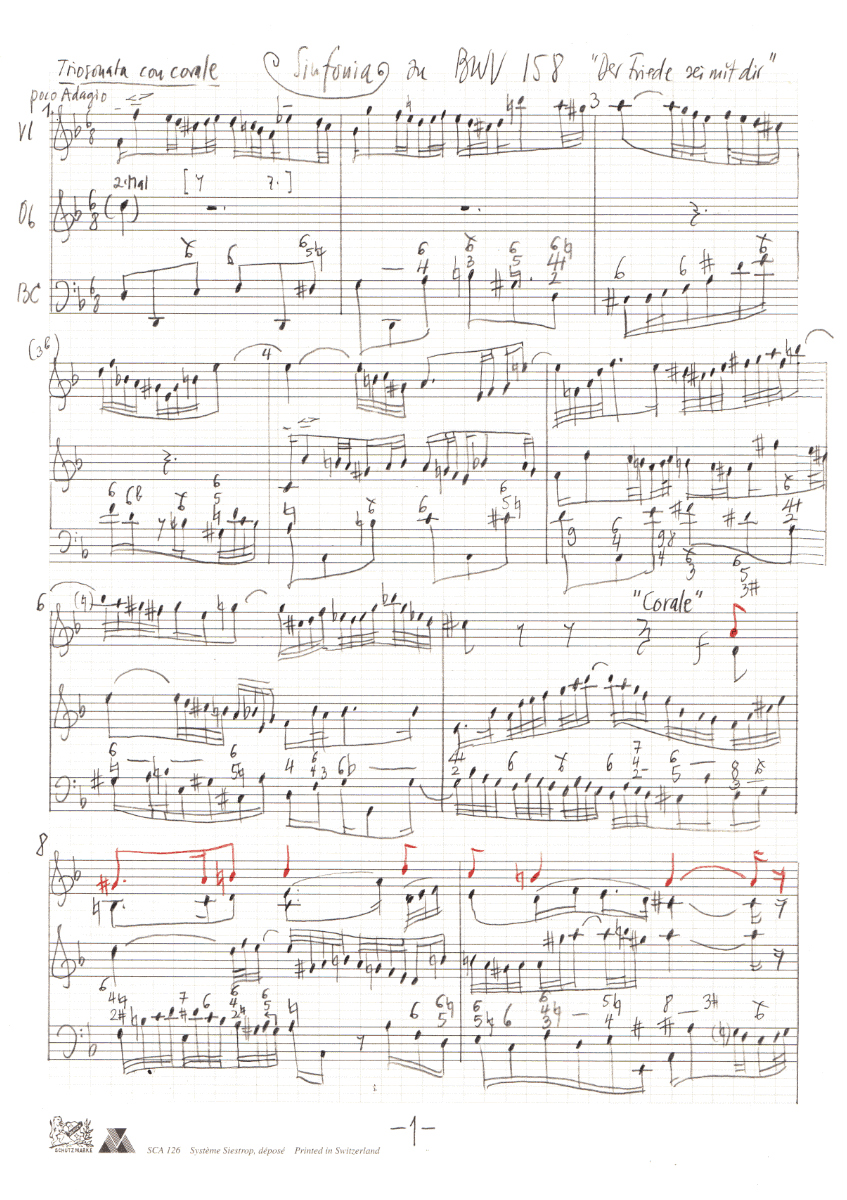
Rudolf Lutz’s addition of a chorale-based sinfonia resolves the unsatisfying musical gaps in this constellation by rounding out and clarifying the Easter relevance of the cantata in a way that was not accomplished by Bach’s contemporaries.
The expansive recitative is set in a style that would be well suited to argumentatively developing the bible dictum of the lost tutti movement, and melds the blessing “May peace now be with thee” – pronounced in arioso style three times throughout the movement – with a memorable recitation describing Easter as the victory of the lamb and the liberation from oppressive law. Here, the key word “peace” is lent a broad interpretation, one that suggests the drying of all tears, the deliverance to a state free of falsity and sorrow, and thus to a meeting between God and man in his natural human state; in this setting, Christ does not speak through the mouth of a priestly intercessor, but rather, “he saith himself to thee” and thus directly to all persons of good will.
The aria and chorale “World, farewell, of thee I’m weary” links the bass’s world-weary rejection of earthly turmoil with a soprano setting of the chorale bearing the same name by Johann Georg Albinus (1649). But in contrast to many other such double movements, Bach does not add the chorale text here to comment on the freely versed text, thus giving voice at a second level to what may have been unutterable by the solo voice. Rather, both text levels here are identical in a way that summons an extraordinary intensity against the backdrop of the Passion. The actual “star” of this setting, however, is the solo violin, which, like in the aria “Keep thou, my heart now, this most blessed wonder” of the Christmas Oratorio, reveals Bach’s special relationship to the instrument that, as a concertmaster, he had fully mastered. Here, the wise naivety and noble cantilena of the violin part lends the movement a heavenly dimension, giving poignant musical expression to earthly suffering and the worthy strivings of humankind to attain a more perfect state.
The bass recitative “O Lord, now govern all my thoughts” returns again to the farewell metaphor of Simeon’s Day and expresses final submission to God’s will. Here, the faithful are not only willing, but sincerely relieved, to lay down their earthly woes and take up the “heavenly crown“ of the righteous. The somewhat abrupt transition to the closing chorale “Here is the proper Easter lamb“ is probably the result of the cantata’s patchy source materials and revision – and yet it can still be appreciated as a theologically sound interpretation of transcendent bliss.
Libretto
1. Rezitativ (Bass)
Der Friede sei mit dir,
du ängstliches Gewissen!
Dein Mittler stehet hier,
der hat dein Schuldenbuch
und des Gesetzes Fluch
verglichen und zerrissen.
Der Friede sei mit dir,
der Fürste dieser Welt,
der deiner Seele nachgestellt,
ist durch des Lammes Blut
bezwungen und gefällt.
Mein Herz, was bist du so betrübt,
da dich doch Gott durch Christum liebt?
Er selber spricht zu mir:
Der Friede sei mit dir!
2. Arie (Bass) und Choral (Sopran)
Welt, ade, ich bin dein müde,
Salems Hütten stehn mir an;
Welt, ade, ich bin dein müde,
ich will nach dem Himmel zu,
wo ich Gott in Ruh und Friede
ewig selig schauen kann.
da wird sein der rechte Friede
und die ewig stolze Ruh.
Da bleib ich, da hab ich Vergnügen
zu wohnen,
da prang ich gezieret mit himmlischen Kronen.
Welt, bei dir ist Krieg und Streit,
nichts denn lauter Eitelkeit;
in dem Himmel allezeit
Friede, Freud und Seligkeit.
3. Rezitativ (Bass)
Nun Herr, regiere meinen Sinn,
damit ich auf der Welt,
so lang es dir mich hier
zu lassen noch gefällt,
ein Kind des Friedens bin,
und laß mich zu dir aus meinen Leiden
wie Simeon in Frieden scheiden!
Da bleib ich, da hab ich Vergnügen
zu wohnen,
da prang ich gezieret mit himmlischen Kronen.
4. Choral
Hier ist das rechte Osterlamm,
davon Gott hat geboten;
das ist hoch an des Kreuzes Stamm
in heißer Lieb gebraten.
Des Blut zeichnet unsre Tür;
das hält der Glaub dem Tode für;
der Würger kann uns nicht rühren.
Alleluja!
Rudolf Lutz’s addition of a chorale-based sinfonia resolves the unsatisfying musical gaps in this constellation by rounding out and clarifying the Easter relevance of the cantata in a way that was not accomplished by Bach’s contemporaries.
All libretti sourced from Neue Bach-Ausgabe. Johann Sebastian Bach. Neue Ausgabe sämtlicher Werke, published by the Johann-Sebastian-Bach-Institut Göttingen and the Bach-Archiv Leipzig, Series I (Cantatas), vol. 1–41, Kassel and Leipzig, 1954–2000.
All in-depth analyses by Anselm Hartinger (English translations/editing by Alice Noger-Gradon/Mary Carozza) based on the following sources: Hans-Joachim Schulze, Die Bach-Kantaten. Einführungen zu sämtlichen Kantaten Johann Sebastian Bachs, Leipzig, 2nd edition, 2007; Alfred Dürr, Johann Sebastian Bach. Die Kantaten, Kassel, 9th edition, 2009, and Martin Petzoldt, Bach-Kommentar. Die geistlichen Kantaten, Stuttgart, vol. 1, 2nd edition, 2005 and vol. 2, 1st edition, 2007.