






Barmherziges Herze der ewigen Liebe
BWV 185 // For the Fourth Sunday after Trinity
(O heart filled with mercy and love everlasting) for soprano, alto, tenor and bass, oboe, strings and continuo.

Place of composition in the church year
Pericopes for Sunday
Pericopes are the biblical readings for each Sunday and feast day of the liturgical year, for which J. S. Bach composed cantatas. More information on pericopes. Further information on lectionaries.
Halleluja! Wohl dem, der den Herrn fürchtet, der grosse Lust hat zu seinen Geboten! Den Frommen geht das Licht auf in der Finsternis von dem Gnädigen, Barmherzigen und Gerechten. Wohl dem, der barmherzig ist und gerne leihet und richtet seine Sachen aus, dass er niemand Unrecht tue!
Denn ich halte dafür, dass dieser Zeit Leiden der Herrlichkeit nicht wert sei, die an uns soll offenbart werden. Denn das ängstliche Harren der Kreatur wartet auf die Offenbarung der Kinder Gottes. Sintemal die Kreatur unterworfen ist der Eitelkeit ohne ihren Willen, sondern um deswillen, der sie unterworfen hat, auf Hoffnung. Denn auch die Kreatur wird frei werden von dem Dienst des vergänglichen Wesens zu der herrlichen Freiheit der Kinder Gottes. Denn wir wissen, dass alle Kreatur sehnt sich mit uns und ängstet sich noch immerdar. Nicht allein aber sie, sondern auch wir selbst, die wir haben des Geistes Erstlinge, sehnen uns auch bei uns selbst nach der Kindschaft und warten auf unseres Leibes Erlösung.
Darum seid barmherzig, wie auch euer Vater barmherzig ist. Richtet nicht, so werdet ihr auch nicht gerichtet. Verdammet nicht, so werdet ihr nicht verdammt. Vergebet, so wird euch vergeben. Gebet, so wird euch gegeben. Ein voll, gedrückt, gerüttelt und überflüssig Mass wird man in euren Schoss geben; denn eben mit dem Mass, mit dem ihr messet, wird man euch wieder messen. Und er sagte ihnen ein Gleichnis: «Kann auch ein Blinder einem Blinden den Weg weisen? Werden sie nicht alle beide in die Grube fallen? Der Jünger ist nicht über seinen Meister; wenn der Jünger ist wie sein Meister, so ist er vollkommen. Was siehest du aber einen Splitter in deines Bruders Auge, und des Balkens in deinem Auge wirst du nicht gewahr? Oder wie kannst du sagen zu deinem Bruder: ‹Halt stille, Bruder, ich will den Splitter aus deinem Auge ziehen›, – und du siehst selbst nicht den Balken in deinem Auge? Du Heuchler, zieh zuvor den Balken aus deinem Auge und siehe dann zu, dass du den Splitter aus deines Bruders Auge ziehest!» 150
Would you like to enjoy our videos ad-free? Subscribe to YouTube Premium now...

By loading the video, you agree to YouTube's privacy policy.
Learn more
Workshop
By loading the video, you agree to YouTube's privacy policy.
Learn more
Reflective lecture
By loading the video, you agree to YouTube's privacy policy.
Learn more
Publikationen zum Werk im Shop


Orchestra
Conductor & cembalo
Rudolf Lutz
Violin
Renate Steinmann, Martin Korrodi
Viola
Susanna Hefti
Violoncello
Martin Zeller
Violone
Iris Finkbeiner
Oboe
Martin Stadler
Bassoon
Susann Landert
Organ
Norbert Zeilberger
Musical director & conductor
Rudolf Lutz
Workshop
Participants
Karl Graf, Rudolf Lutz
Reflective lecture
Speaker
Pia Reinacher
Recording & editing
Recording date
07/29/2007
Recording location
Trogen
Sound engineer
Stefan Ritzenthaler
Director
Meinrad Keel
Production manager
Johannes Widmer
Production
GALLUS MEDIA AG, Switzerland
Producer
J.S. Bach Foundation of St. Gallen, Switzerland
Librettist
Text
Salomo Franck, 1715
Text No. 6
Johann Agricola, 1529
First performance
Unknown
In-depth analysis
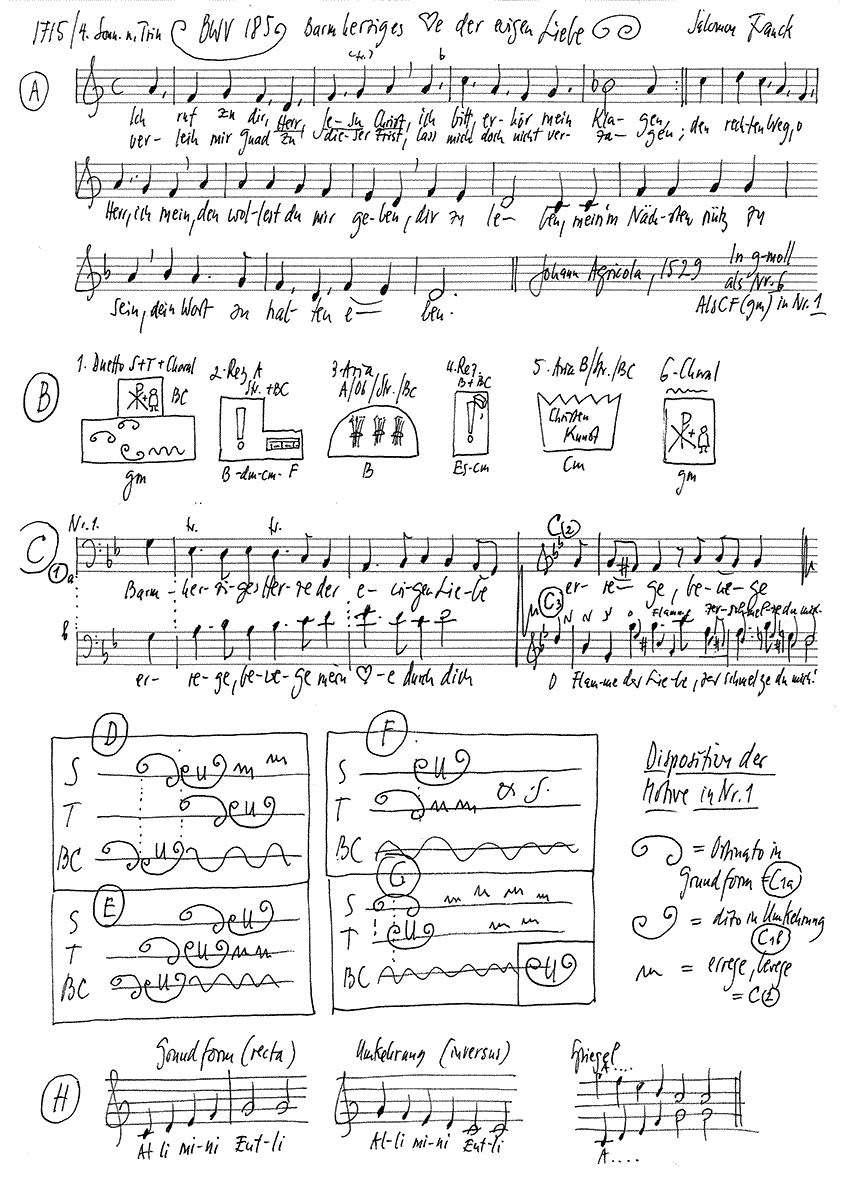
The cantata “Barmherziges Herze der ewigen Liebe” (O heart filled with mercy and love everlasting) belongs to a group of works stemming from Bach’s Weimar period that the composer reworked during his tenure as Thomascantor in Leipzig. Composed in 1715 to a libretto by Weimar court librarian Salomo Franck, the cantata was likely reperformed in Weimar a second time, before being revived in 1723 and again in the mid-1740s for church services in Leipzig.
Like several cantatas of Bach’s Weimar period, the work opens not with a typical tutti setting but with a soprano and tenor duet whose continuo accompaniment sets the mood with lilting 6⁄8 figures. Here, the notion that mercy and love are a part of the give and take between two individuals is expressed at a structural level through the scoring for two soloists. The covert star of the mellifluous and consonant setting, however, is the oboe, which presents the chorale melody “Ich ruf zu dir, Herr Jesu Christ” (I call to thee, Lord Jesus Christ) in a high register; in Leipzig, Bach reassigned the part to a trumpet or horn to suit the larger churches there.
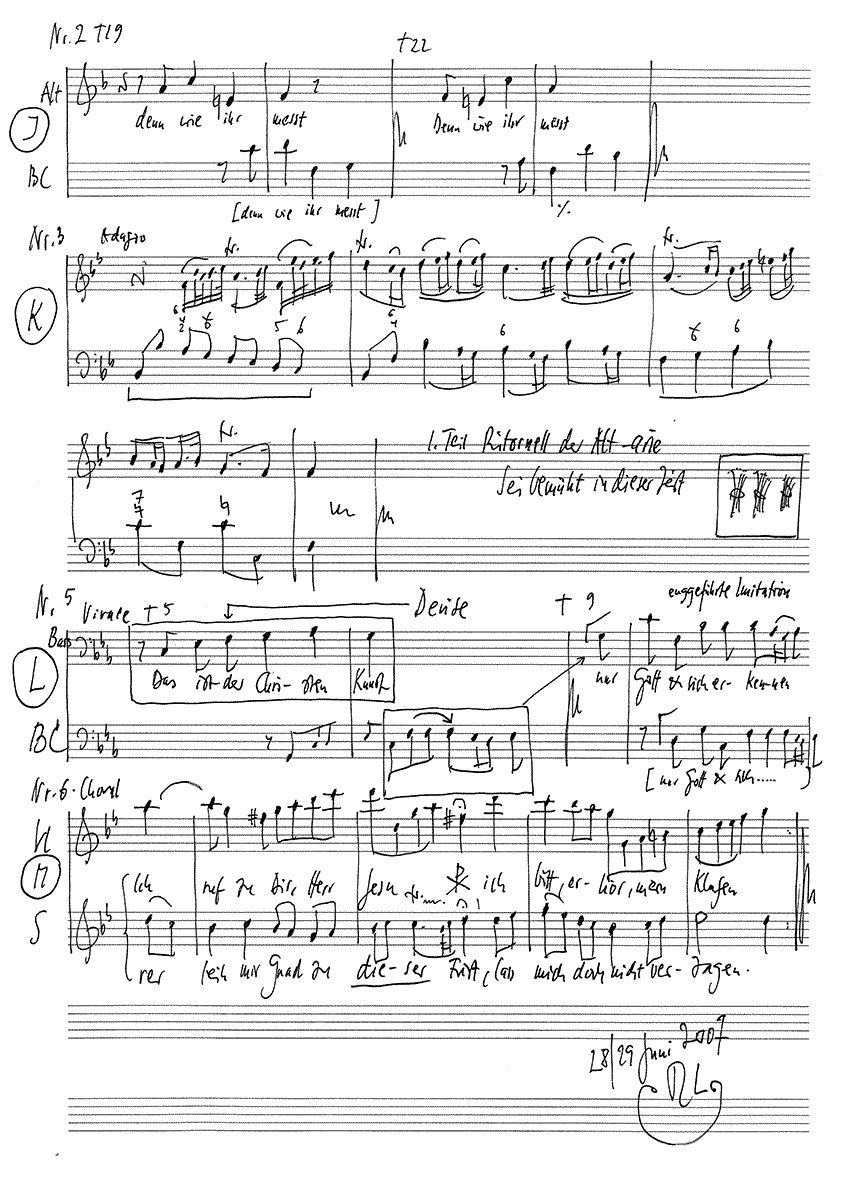
With its pianissimo strings gleaming like a halo over the gentle entreaties of the alto soloist, the following recitative offers a musical image of forgiveness that overcomes the hardest of hearts. Franck’s powerful language enables Bach to shape a setting that is cohesive in its overall effect yet sensitive in its rendering of each phrase. Indeed, in the central section of the movement, set to the words “Vergebt – so wird euch auch vergeben” (Forgive and ye will be forgiven), the message that there will always be ample scope for humans to act in faith is made tangible in particularly inspiring fashion.
While Martin Luther’s liberating doctrine of justification through faith struggled to motivate humans to nevertheless perform good deeds, in the alto aria, Bach and Franck have a ready answer that cuts straight to the heart: the setting makes it nigh impossible to resist the shimmering magic of the act of giving, drawn out in the slowest of tempos. “Sei bemüht, in dieser Zeit, Seele reichlich auszustreuen” (Be concerned within this life, Spirit, ample seed to scatter) – what the strings and oboe celebrate step by step in this celebratory A major movement is nothing less than the infectious kindness of a life transformed by the Gospel.
Had modern media existed in Bach’s times, the following recitative on the trials and tribulations of earthly life could well have served as a short sermon for radio and television. The libretto, drawing on biblical parables, summons humans to free themselves of foolish “Eigenliebe” (selfishness) and to be aware of the plank in their own eye before removing the speck from another’s – a practical homily for life that Bach portrays word for word, and perhaps even with a knowing wink.
In the following aria, these moral principles are elevated to a model of Christian ethics: “Das ist der Christen Kunst, nur Gott und sich erkennen” (This is the Christian skill, but God and self discerning). While the bass cantilena serenely takes on this norm, the main interpretive gesture lies concealed in the instrumental scoring: not only do all strings play the same part in unison, but the continuo, too, toes the party line, echoing precisely the same part one octave lower. Indeed, reconciling God and Self could hardly be better expressed than in this low register miniature, in which even Bach has chosen to eschew practically every form of artistic embellishment.
By way of compensation, Bach furnishes the closing chorale – the first verse of the supplication hymn “Ich ruf zu dir, Herr Jesu Christ” (I call to thee, Lord Jesus Christ) by Johann Agricola (1530) – with an obbligato violin part that, like a radiant morning star, shines above the four-part vocal setting, illuminating the “rechter Weg” (proper path) of faith and Christian love.
Libretto
1. Arie Duett und Choral (Sopran und Tenor)
Barmherziges Herze der ewigen Liebe,
errege, bewege mein Herze durch dich;
damit ich Erbarmen und Gütigkeit übe,
o Flamme der Liebe, zerschmelze du mich!
Barmherziges Herze der ewigen Liebe,
errege, bewege mein Herze durch dich!
2. Rezitativ (Alt)
Ihr Herzen, die ihr euch
in Stein und Fels verkehret,
zerfließt und werdet weich;
erwägt, was euch der Heiland lehret,
übt, übt Barmherzigkeit
und sucht noch auf der Erden
dem Vater gleich zu werden.
Ach! greifet nicht
durch das verbotne Richten
dem Allerhöchsten ins Gericht,
sonst wird sein Eifer euch zernichten.
Vergebt, so wird euch auch vergeben;
gebt, gebt in diesem Leben;
macht euch ein Kapital,
das dort einmal
Gott wiederzahlt mit reichen Interessen;
denn wie ihr meßt, wird man euch wieder messen.
3. Arie (Alt)
Sei bemüht in dieser Zeit,
Seele, reichlich auszustreuen,
soll die Ernte dich erfreuen
in der reichen Ewigkeit,
wo, wer Gutes ausgesäet,
fröhlich nach den Garben gehet.
4. Rezitativ (Bass)
Die Eigenliebe schmeichelt sich.
Bestrebe dich,
erst deinen Balken auszuziehen,
dann magst du dich um Splitter auch bemühen,
die in des Nächsten Augen sein.
Ist gleich dein Nächster nicht vollkommen rein,
so wisse, daß auch du kein Engel,
verbeßre deine Mängel!
Wie kann ein Blinder mit dem andern
doch recht und richtig wandern?
Wie, fallen sie zu ihrem Leide
nicht in die Gruben alle beide?
5. Arie (Bass)
Das ist der Christen Kunst:
nur Gott und sich erkennen,
von wahrer Liebe brennen,
nicht unzulässig richten,
noch fremdes Tun vernichten,
des Nächsten nicht vergessen,
mit reichem Maße messen,
das macht bei Gott und Menschen Gunst,
das ist der Christen Kunst.
6. Choral
Ich ruf zu dir, Herr Jesu Christ,
ich bitt, erhör mein Klagen,
verleih mir Gnad zu dieser Frist,
laß mich doch nicht verzagen;
den rechten Weg, o Herr, ich mein,
den wollest du mir geben,
dir zu leben,
mein’m Nächsten nütz zu sein,
dein Wort zu halten eben.
All libretti sourced from Neue Bach-Ausgabe. Johann Sebastian Bach. Neue Ausgabe sämtlicher Werke, published by the Johann-Sebastian-Bach-Institut Göttingen and the Bach-Archiv Leipzig, Series I (Cantatas), vol. 1–41, Kassel and Leipzig, 1954–2000.
All in-depth analyses by Anselm Hartinger (English translations/editing by Alice Noger-Gradon/Mary Carozza) based on the following sources: Hans-Joachim Schulze, Die Bach-Kantaten. Einführungen zu sämtlichen Kantaten Johann Sebastian Bachs, Leipzig, 2nd edition, 2007; Alfred Dürr, Johann Sebastian Bach. Die Kantaten, Kassel, 9th edition, 2009, and Martin Petzoldt, Bach-Kommentar. Die geistlichen Kantaten, Stuttgart, vol. 1, 2nd edition, 2005 and vol. 2, 1st edition, 2007.