




Was mein Gott will, das g’scheh allzeit
BWV 111 // For the Third Sunday after Epiphany
(What my God will, be done alway) for soprano, alto, tenor and bass, vocal ensemble, oboe I+II, bassoon, strings and continuo
The cantata “Was mein Gott will, das g’scheh allzeit” (What my God will be done always) was composed for the Third Sunday after Epiphany in 1725. With its sustained thematic treatment of the chorale melody, concertostyle elements, and sensitive interpretation of the text and hymns, it is stylistically typical of the large-scale chorale cantata cycle of 1724–25 to which it belongs.
Place of composition in the church year
Pericopes for Sunday
Pericopes are the biblical readings for each Sunday and feast day of the liturgical year, for which J. S. Bach composed cantatas. More information on pericopes. Further information on lectionaries.
Herr, wie lange willst du mein so gar vergessen? Wie lange verbirgst du dein Antlitz vor mir? Wie lange soll ich sorgen in meiner Seele und mich ängsten in meinem Herzen täglich? Wie lange soll sich mein Feind über mich erheben? – Ich hoffe aber darauf, dass du so gnädig bist; mein Herz freut sich, dass du so gerne hilfst. Ich will dem Herrn singen, dass er so wohl an mir tut.
Haltet euch nicht selbst für klug. Vergeltet niemand Böses mit Bösem. Fleissiget euch der Ehrbarkeit gegen jedermann. Ist es möglich, soviel an euch ist, so habt mit allen Menschen Frieden. Rächet euch selber nicht, meine Liebsten, sondern gebet Raum dem Zorn [Gottes]; denn es steht geschrieben: «‹Die Rache ist mein; ich will vergelten›, spricht der Herr.» So nun deinen Feind hungert, so speise ihn; dürstet ihn, so tränke ihn. Wenn du das tust, so wirst du feurige Kohlen auf sein Haupt sammeln. Lass dich nicht das Böse überwinden, sondern überwinde das Böse mit Gutem.
Da er aber vom Berge herabging, folgte ihm viel Volks nach. Und siehe, ein Aussätziger kam und betete ihn an und sprach: «Herr, so du willst, kannst du mich wohl reinigen.» Und Jesus streckte seine Hand aus, rührte ihn an und sprach: «Ich will’s; sei gereinigt!» Und alsbald ward er von seinem Aussatz rein. Und Jesus sprach zu ihm: «Siehe zu, sage es niemand; sondern gehe hin und zeige dich dem Priester und opfere die Gabe, die Mose befohlen hat, zum Zeugnis über sie.» Da aber Jesus einging zu Kapernaum, trat ein Hauptmann zu ihm, der bat ihn und sprach: «Herr, mein Knecht liegt zu Hause und ist gichtbrüchig und hat grosse Qual.» Jesus sprach zu ihm: «Ich will kommen und ihn gesund machen.» Der Hauptmann antwortete und sprach: «Herr, ich bin nicht wert, dass du unter mein Dach gehest; sondern sprich nur ein Wort, so wird mein Knecht gesund. Denn ich bin ein Mensch, der Obrigkeit untertan, und habe unter mir Kriegsknechte; und wenn ich sage zu einem: Gehe hin!, so geht er; und zum andern: Komm her!, so kommt er; und zu meinem Knecht: Tu das!, so tut er’s.» Da Jesus das hörte, verwunderte er sich und sprach zu denen, die ihm nachfolgten: «Wahrlich, ich sage euch: Solchen Glauben habe ich in Israel nicht gefunden! Aber ich sage euch: Viele werden kommen vom Morgen und vom Abend und mit Abraham und Isaak und Jakob im Himmelreich sitzen; aber die Kinder des Reichs werden ausgestossen in die Finsternis hinaus; da wird sein Heulen und Zähneklappern.» Und Jesus sprach zu dem Hauptmann: «Gehe hin; dir geschehe, wie du geglaubt hast.» Und sein Knecht ward gesund zu derselben Stunde.
Would you like to enjoy our videos ad-free? Subscribe to YouTube Premium now...

By loading the video, you agree to YouTube's privacy policy.
Learn more
Workshop
By loading the video, you agree to YouTube's privacy policy.
Learn more
Reflective lecture
By loading the video, you agree to YouTube's privacy policy.
Learn more
Publikationen zum Werk im Shop


Choir
Soprano
Susanne Frei, Olivia Fündeling, Guro Hjemli, Noëmi Sohn Nad, Noëmi Tran Rediger
Alto
Jan Börner, Antonia Frey, Damaris Nussbaumer, Lea Scherer
Tenor
Marcel Fässler, Manuel Gerber, Nicolas Savoy
Bass
Fabrice Hayoz, Manuel Walser, Philippe Rayot
Orchestra
Conductor & cembalo
Rudolf Lutz
Violin
Renate Steinmann, Dorothee Mühleisen
Viola
Susanna Hefti
Violoncello
Maya Amrein
Violone
Iris Finkbeiner
Oboe
Kerstin Kramp, Andreas Helm
Bassoon
Susann Landert
Organ
Nicola Cumer
Musical director & conductor
Rudolf Lutz
Workshop
Participants
Karl Graf, Rudolf Lutz
Reflective lecture
Speaker
Bernd Rüthers
Recording & editing
Recording date
01/20/2012
Recording location
Trogen
Sound engineer
Stefan Ritzenthaler
Director
Meinrad Keel
Production manager
Johannes Widmer
Production
GALLUS MEDIA AG, Switzerland
Producer
J.S. Bach Foundation of St. Gallen, Switzerland
Librettist
Text No. 1
Herzog Albrecht von Preussen, 1547
Text No. 2–6
Unknown author
First performance
Third Sunday after Epiphany,
21 January 1725
In-depth analysis
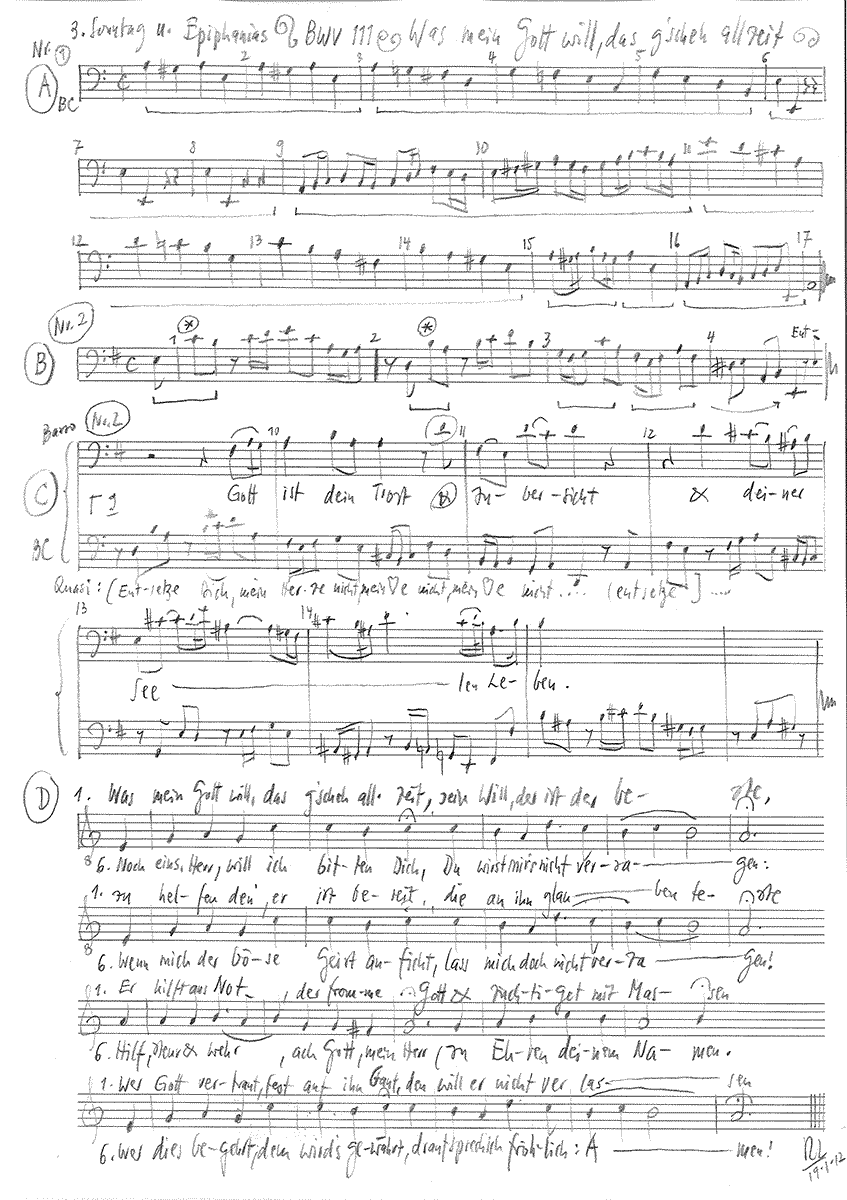
The archaic Trutzlied by Duke Albrecht of Prussia, who converted to Lutheranism in 1525 and was the last Grand Master of the Teutonic Knights, provides the inspiration for Bach’s spirited introductory chorus. Dominated by a soprano melody delivered in long notes, the vocal line-by-line delivery of the chorale is embedded in a powerful instrumental setting of alternating string and oboe lines over a driving continuo part. The dynamic unison passages of two violins and a viola underscore the atmosphere of simmering religious tension, but suggest at the same time the stabilising presence of the Holy Trinity. Like the introductory chorus of the 1726 cantata “Alles nur nach Gottes Willen” (All things but as God is willing) – also composed for the Third Sunday after Epiphany – the movement employs a succinct motive of descending fourths which, according to Rudolf Lutz, appear to represent a resolute will to subject “all things” to the rule of God.
The following aria stands in striking contrast to the introductory section. Scored for solo bass and continuo, this invention for two lower voices unfolds as an inimitably complex yet convincing interplay of lines that is characterised by the contradictory statement “Be frightened, O my bosom, not” and the effective melisma drawing out the word “resistance”.
In the alto recitative, large leaps and dissonant intervals illustrate the folly of trying to escape the will of God, to whom even “our very thoughts are manifest”. While the libretto denounces this behaviour as a transgression, making reference to Jonah, the reluctant, old-testament prophet, Bach underscores with a harsh false relation the “foolishness” of fleeing from God ere the smooth vocal phrases render plausible the “faithful trust” in his “protection”.
The following alto and tenor aria is based on one of the most dramatically conflicting text passages that Bach ever set: “I’ll walk, then, with emboldened paces, E’en when me God to grave shall lead”. Here, the determined and almost dance-like ascending string passages are countered by weighty pedal points and descending continuo passages which represent the grave and eternal sleep: without accepting the inevitability of death, heaven and eternity remain beyond reach. The fact that the alto and tenor voices are literally trapped between the trusting strides of the strings and the deathly pull of the continuo renders these dual extremes of human existence palpably audible. The virtuoso coloraturas of the first violin, too, seem to hover around a single note – the tension between stillness and movement, a yearning for death and worldly activity seem to permeate every nuance of the movement. While the fugue-like imitation in the middle section accentuates the aspect of time and its measured course (“As God my days has set in writing”), a sense of loving trust retains the upper hand with the recapitulation of the A section. Formally, the aria’s setting as an intense duet is symbolic of the companionship necessary to find the comfort and courage to take the final steps in life. Bach, who was sorely tested as both orphan and widower, has realised here a strong image of the kind-hearted guide, whose gentle power of persuasion cannot be resisted.
The following soprano recitative is, most unusually, accompanied by two obbligato oboes. While this initially appears to suggest a pastoral scene, it emerges in the quavering, adagio closing passage as a symbol of the death knell and the “blessed, desirable end”. The closing chorale with its beautifully extended “Amen” maintains this earnest tone while simultaneously transforming it into both a congregational hymn and an individual prayer: “Just this, Lord, will I ask of thee”.
Libretto
1. Chor
Was mein Gott will, das g’scheh allzeit,
sein Will, der ist der beste,
zu helfen den’ er ist bereit,
die an ihn glauben feste.
Er hilft aus Not, der fromme Gott,
und züchtiget mit Massen.
Wer Gott vertraut, fest auf ihn baut,
den will er nicht verlassen.
2. Arie (Bass)
Entsetze dich, mein Herze, nicht,
Gott ist dein Trost und Zuversicht
und deiner Seelen Leben.
Ja, was sein weiser Rat bedacht,
dem kann die Welt und Menschenmacht
unmöglich widerstreben.
3. Rezitativ (Alt)
O Törichter, der sich von Gott entzieht,
und wie ein Jonas dort
vor Gottes Angesichte flieht;
auch unser Denken ist ihm offenbar,
und unsers Hauptes Haar
hat er gezählet.
Wohl dem, der diesen Schutz erwählet
im gläubigen Vertrauen,
auf dessen Schluss und Wort
mit Hoffnung und Geduld zu schauen.
4. Arie (Duett Alt, Tenor)
So geh ich mit beherzten Schritten,
auch wenn mich Gott zum Grabe führt.
Gott hat die Tage aufgeschrieben,
so wird, wenn seine Hand mich rührt,
des Todes Bitterkeit vertrieben.
5. Rezitativ (Sopran)
Drum wenn der Tod zuletzt den Geist
noch mit Gewalt aus seinem Körper reisst,
so nimm ihn, Gott, in treue Vaterhände;
wenn Teufel, Tod und Sünde mich bekriegt
und meine Sterbekissen
ein Kampfplatz werden müssen,
so hilf, damit in dir mein Glaube siegt.
O seliges, gewünschtes Ende!
6. Choral
Noch eins, Herr, will ich bitten dich,
du wirst mir’s nicht versagen:
Wenn mich der böse Geist anficht,
lass mich doch nicht verzagen!
Hilf, steur und wehr, ach Gott, mein Herr,
zu Ehren dienem Namen.
Wer das begehrt, dem wird’s gewährt;
drauf sprech ich fröhlich: Amen!
All libretti sourced from Neue Bach-Ausgabe. Johann Sebastian Bach. Neue Ausgabe sämtlicher Werke, published by the Johann-Sebastian-Bach-Institut Göttingen and the Bach-Archiv Leipzig, Series I (Cantatas), vol. 1–41, Kassel and Leipzig, 1954–2000.
All in-depth analyses by Anselm Hartinger (English translations/editing by Alice Noger-Gradon/Mary Carozza) based on the following sources: Hans-Joachim Schulze, Die Bach-Kantaten. Einführungen zu sämtlichen Kantaten Johann Sebastian Bachs, Leipzig, 2nd edition, 2007; Alfred Dürr, Johann Sebastian Bach. Die Kantaten, Kassel, 9th edition, 2009, and Martin Petzoldt, Bach-Kommentar. Die geistlichen Kantaten, Stuttgart, vol. 1, 2nd edition, 2005 and vol. 2, 1st edition, 2007.