






Ich habe meine Zuversicht
BWV 188 // For the Twenty-first Sunday after Trinity
(I have now all my confidence) for soprano, alto, tenor and bass, oboe I+II, taille, organo obbligato, bassoon and strings

Place of composition in the church year
Pericopes for Sunday
Pericopes are the biblical readings for each Sunday and feast day of the liturgical year, for which J. S. Bach composed cantatas. More information on pericopes. Further information on lectionaries.
Herr, lehre doch mich, dass es ein Ende mit mir haben muss und mein Leben ein Ziel hat und ich davon muss. Siehe, meine Tage sind einer Hand breit bei dir, und mein Leben ist wie nichts vor dir. Wie gar nichts sind alle Menschen, die doch so sicher leben! Sie gehen daher wie ein Schemen und machen sich viel vergebliche Unruhe; sie sammeln und wissen nicht, wer es einnehmen wird. Nun, Herr, wes soll ich mich trösten? Ich hoffe auf dich.
Zuletzt, meine Brüder, seid stark in dem Herrn und in der Macht seiner Stärke. Ziehet an den Harnisch Gottes, dass ihr bestehen könnet gegen die listigen Anläufe des Teufels. Denn wir haben nicht mit Fleisch und Blut zu kämpfen, sondern mit Fürsten und Gewaltigen, nämlich mit den Herren der Welt, die in der Finsternis dieser Welt herrschen, mit den bösen Geistern unter dem Himmel. Um deswillen ergreifet den Harnisch Gottes, auf dass ihr an dem bösen Tage Widerstand tun und alles wohl ausrichten und das Feld behalten möget. So stehet nun, umgürtet an euren Lenden mit Wahrheit und angezogen mit dem Panzer der Gerechtigkeit und an den Beinen gestiefelt, als fertig, zu treiben das Evangelium des Friedens. Vor allen Dingen aber ergreifet den Schild des Glaubens, mit welchem ihr auslöschen könnt alle feurigen Pfeile des Bösewichts; und nehmet den Helm des Heils und das Schwert des Geistes, welches ist das Wort Gottes.
Und es war ein Königischer, des Sohn lag krank zu Kapernaum. Dieser hörte, dass Jesus kam aus Judäa nach Galiläa, und ging hin zu ihm und bat ihn, dass er hinabkäme und hülfe seinem Sohn; denn er war todkrank. Und Jesus sprach zu ihm: «Wenn ihr nicht Zeichen und Wunder sehet, so glaubet ihr nicht.» Der Königische sprach zu ihm: «Herr, komm hinab, ehe denn mein Kind stirbt!» Jesus spricht zu ihm: «Gehe hin, dein Sohn lebt!» Der Mensch glaubte dem Wort, das Jesus zu ihm sagte, und ging hin. Und indem er hinabging, begegneten ihm seine Knechte, verkündigten ihm und sprachen: «Dein Kind lebt!» Da forschte er von ihnen die Stunde, in welcher es besser mit ihm geworden war. Und sie sprachen zu ihm: «Gestern um die siebente Stunde verliess ihn das Fieber.» Da merkte der Vater, dass es um die Stunde wäre, in welcher Jesus zu ihm gesagt hatte: «Dein Sohn lebt.» Und er glaubte mit seinem ganzen Hause. Das ist nun das andere Zeichen, das Jesus tat, da er aus Judäa nach Galiläa kam.
Would you like to enjoy our videos ad-free? Subscribe to YouTube Premium now...

By loading the video, you agree to YouTube's privacy policy.
Learn more
Workshop
By loading the video, you agree to YouTube's privacy policy.
Learn more
Reflective lecture
By loading the video, you agree to YouTube's privacy policy.
Learn more
Publikationen zum Werk im Shop


Orchestra
Conductor & cembalo
Rudolf Lutz
Violin
Plamena Nikitassova, Renate Steinmann, Christine Baumann, Martin Korrodi, Dorothee Mühleisen, Ildiko Sajgo
Viola
Susanna Hefti, Martina Bischof
Violoncello
Martin Zeller, Hristo Kouzmanov
Violone
Iris Finkbeiner
Oboe
Kerstin Kramp, Ingo Müller
Oboe da caccia
Dominik Melicharek
Taille
Dominik Melicharek
Bassoon
Susann Landert
Organo Obbligato
Jörg Andreas Boetticher
Musical director & conductor
Rudolf Lutz
Workshop
Participants
Karl Graf, Rudolf Lutz
Reflective lecture
Speaker
Hanna Johansen
Recording & editing
Recording date
10/26/2012
Recording location
Trogen
Sound engineer
Stefan Ritzenthaler
Director
Meinrad Keel
Production manager
Johannes Widmer
Production
GALLUS MEDIA AG, Switzerland
Producer
J.S. Bach Foundation of St. Gallen, Switzerland
Librettist
Text No. 1–5
Christian Friedrich Henrici,
known as Picander (1700–1764)
Text No. 6
Poet unknown
First performance
Twenty-first Sunday after Trinity,
17 October 1728
In-depth analysis
After reworking the first two movements of some concerto material (that would later be known as harpsicord concerto BWV 1052) for cantata BWV 146, Bach returned to the same work in 1728, this time adapting the third movement for cantata BWV 188 “Ich habe meine Zuversicht” (I have now all my confidence), which he composed as figural music for the Twenty-First Sunday after Trinity. The work begins with a somewhat traditional sinfonia that serves as the grand opening gesture in place of an introductory chorus. With its commanding virtuosity, probing length and gritty resolve, the movement sets a distinctive tone that no doubt captured the attention of listeners – the Thomas cantor, who towards the end of the 1720s had increasingly distanced himself from the weekly production and performance of new cantatas, was evidently back at the helm. Due to the work’s complicated transmission history, the orchestral parts of this concerto movement can be reconstructed only to a limited extent.
After the relentless D-minor music of the sinfonia, the F-major tonality of the tenor aria radiates an introspective luminance that conjures an image of “Zuversicht” (confidence) long before the word itself is sung. In this setting, the solo oboe with the trusting tones of its bridging phrases lends the dance-like string setting a brilliance that allows even the everthreatening collapse of earthly order described in the middle section to fade away behind the image of a faithful God.
The bass recitative lends expression to the trust in God’s benevolence and leadership that enables the faithful to overcome all their suffering. With deep psychological empathy, the text resorts to ever-stronger metaphors that depict even the wrath of the heavenly Father as a well-measured dose of love – suitably crowned by a touching arioso on Jacob’s famous words from Genesis 32, “Ich laße dich nicht, du segnest mich denn” (I’ll not let him go, until he me bless), which hark back to when he wrestled with God on the banks of the river Jabbok.
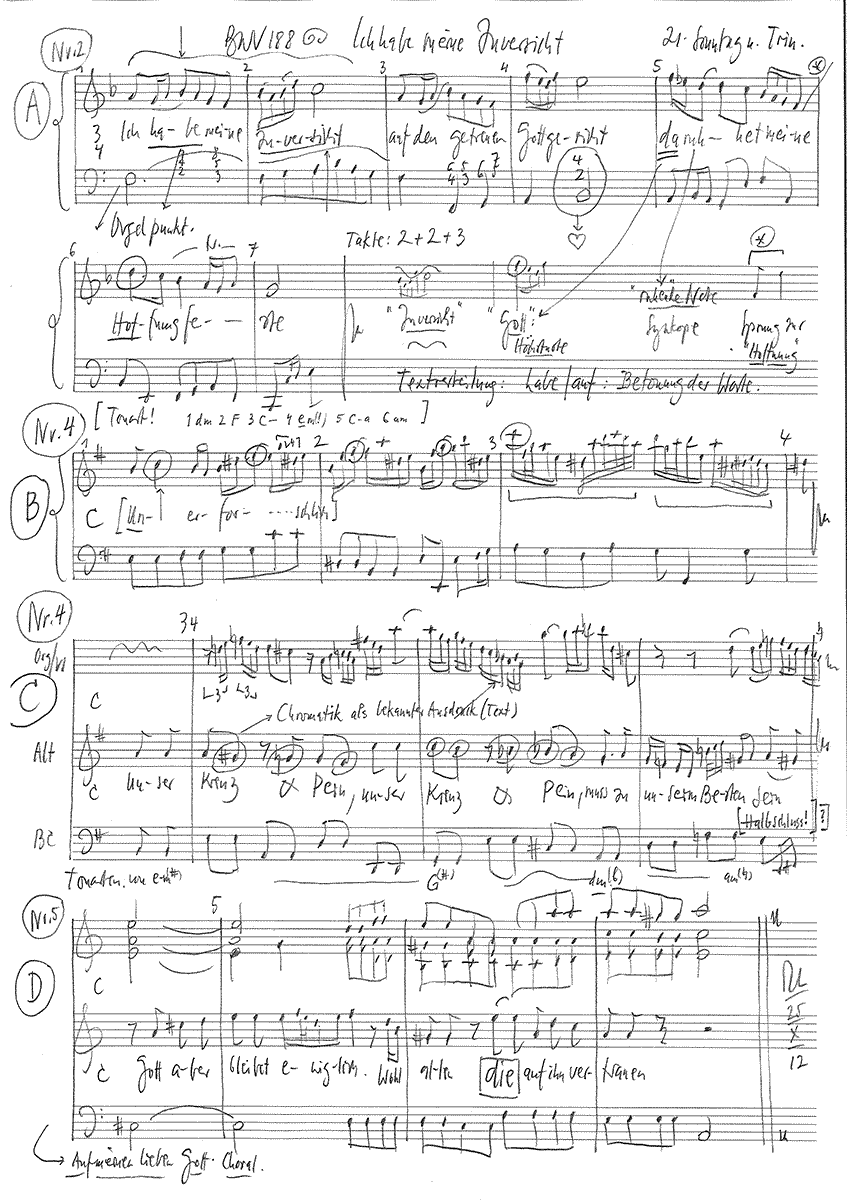
The following alto aria, however, leaves no doubt that the relationship between God the creator and humankind is not of an ordinary transactional nature, but a mystical, transcendent happening. “Unerforschlich” (Not to fathom), namely unpredictable and thus hardly to be influenced, “ist die Weise, wie der Herr die Seinen führt” (is the manner how the Lord his people leads) – here, what is nigh impossible for theology and reason to impart and comprehend, namely acceptance of our cross-to-bear, is made directly plausible and transformed into a source of solace through the enraptured circling figures of the violin (our chosen obbligato instrument), the adorations voiced by the alto soloist and the ardent D-minor momentum of the lilting continuo quavers. When Martin Luther spoke of music’s unique capacity to breathe life into the word of the Bible, then Bach achieved precisely that in a way that is both exemplary and, much like the actual import of the setting, almost “not to fathom”.
That humankind can and should draw the necessary energy from this spiritual resource to overcome their struggles and difficulties is underscored in the short but weighty soprano accompagnato “Die Macht der Welt verlieret sich, wer kann auf Stand und Hoheit bauen” (The world’s great might shall disappear, who can depend on rank and honour?). In this setting, what – in just a few devastating words – makes all hierarchy and violence recede in God’s eternal presence is echoed in the string accompaniment’s shift from hectic repeated semiquaver figures to calm, flowing quaver lines.
After this efficient deployment of compositional resources, we lack only a chorale to welcome the congregation to this alliance of empowering trust. First printed in 1607, the chorale verse “Auf meinen lieben Gott” (In my beloved God) cuts to the heart of this unifying message in simple yet masterly fashion. The notion of “Rettung” (salvage) so prominently raised in this verse also applies in a broader sense to the cantata itself: in the nineteenth century, Bach’s autograph copy of the score was cut into innumerable pieces of memorabilia and distributed across the globe, leaving scholars dependent on secondary sources to reconstruct the cantata.
Libretto
1. Sinfonia
2. Arie (Tenor)
Ich habe meine Zuversicht
auf den getreuen Gott gericht’,
da ruhet meine Hoffnung feste.
Wenn alles bricht, wenn alles fällt,
wenn niemand Treu und Glauben hält,
so ist doch Gott der allerbeste
3. Rezitativ (Bass)
Gott meint es gut mit jedermann,
auch in den allergrößten Nöten.
Verbirget er gleich seine Liebe,
so denkt sein Herz doch heimlich dran;
das kann er niemals nicht entziehn,
und wollte mich der Herr auch töten,
so hoff ich doch auf ihn.
Denn sein erzürntes Angesicht
ist anders nicht als eine Wolke trübe,
sie hindert nur den Sonnenschein,
damit durch einen sanften Regen
der Himmelssegen
um so viel reicher möge sein.
Der Herr verwandelt sich in einen Grausamen,
um desto tröstlicher zu scheinen;
er will, er kanns nicht böse meinen.
Drum laß ich ihn nicht, er segne mich denn.
4. Arie (Alt)
Unerforschlich ist die Weise,
wie der Herr die Seinen führt.
Selber unser Kreuz und Pein
muß zu unserm Besten sein
und zu seines Namens Preise.
5. Rezitativ (Sopran)
Die Macht der Welt verlieret sich.
Wer kann auf Stand und Hoheit bauen?
Gott aber bleibet ewiglich.
Wohl allen, die auf ihn vertrauen!
6. Choral
Auf meinen lieben Gott
trau ich in Angst und Not;
er kann mich allzeit retten
aus Trübsal, Angst und Nöten,
mein Unglück kann er wenden,
steht alls in seinen Händen.
All libretti sourced from Neue Bach-Ausgabe. Johann Sebastian Bach. Neue Ausgabe sämtlicher Werke, published by the Johann-Sebastian-Bach-Institut Göttingen and the Bach-Archiv Leipzig, Series I (Cantatas), vol. 1–41, Kassel and Leipzig, 1954–2000.
All in-depth analyses by Anselm Hartinger (English translations/editing by Alice Noger-Gradon/Mary Carozza) based on the following sources: Hans-Joachim Schulze, Die Bach-Kantaten. Einführungen zu sämtlichen Kantaten Johann Sebastian Bachs, Leipzig, 2nd edition, 2007; Alfred Dürr, Johann Sebastian Bach. Die Kantaten, Kassel, 9th edition, 2009, and Martin Petzoldt, Bach-Kommentar. Die geistlichen Kantaten, Stuttgart, vol. 1, 2nd edition, 2005 and vol. 2, 1st edition, 2007.