






Herr Jesu Christ, wahr’ Mensch und Gott
BWV 127 // For Estomihi
(Lord Jesus Christ, true man and God) for soprano, tenor and bass, vocal ensemble, flauto I+II, oboe I+II, trumpet, strings and basso continuo
Cantata BWV 127 was composed for Estomihi in 1725. It is widely considered one of the highlights of Bach’s chorale cantata cycle, no doubt by virtue of its motivic density and its nigh perfect balance between sensitive textual interpretation and dramatic presence. The original trumpet part is lost, yet the instrument is essential to the fear of last judgement expressed in the text; it is thus a decision of performance practice whether to include trumpets in the outer movements.
Place of composition in the church year
Pericopes for Sunday
Pericopes are the biblical readings for each Sunday and feast day of the liturgical year, for which J. S. Bach composed cantatas. More information on pericopes. Further information on lectionaries.
Herr, auf dich traue ich, lass mich nimmermehr zu Schanden werden; errette mich durch deine Gerechtigkeit! – Neige deine Ohren zu mir, eilend hilf mir! Sei mir ein starker Fels und eine Burg, dass du mir helfest! – In deine Hände befehle ich meinen Geist; denn du hast mich erlöst, Herr, du treuer Gott.
Wenn ich mit Menschen- und mit Engelszungen redete und hätte der Liebe nicht, so wäre ich ein tönend Erz oder eine klingende Schelle. Und wenn ich weissagen könnte und wüsste alle Geheimnisse und alle Erkenntnis und hätte allen Glauben, also dass ich Berge versetzte, und hätte der Liebe nicht, so wäre ich nichts. Und wenn ich alle meine 85 Habe den Armen gäbe und liesse meinen Leib brennen und hätte der Liebe nicht, so wäre mir’s nichts nütze. Die Liebe ist langmütig und freundlich, die Liebe eifert nicht, die Liebe treibt nicht Mutwillen, sie blähet sich nicht, sie stellet sich nicht ungebärdig, sie suchet nicht das Ihre, sie lässt sich nicht erbittern, sie rechnet das Böse nicht zu, sie freuet sich nicht der Ungerechtigkeit, sie freuet sich aber der Wahrheit; sie verträgt alles, sie glaubet alles, sie hoffet alles, sie duldet alles. Die Liebe höret nimmer auf, so doch die Weissagungen aufhören werden und die Sprachen aufhören werden und die Erkenntnis aufhören wird. Denn unser Wissen ist Stückwerk, und unser Weissagen ist Stückwerk. Wenn aber kommen wird das Vollkommene, so wird das Stückwerk aufhören. Da ich ein Kind war, da redete ich wie ein Kind und war klug wie ein Kind und hatte kindische Anschläge; da ich aber ein Mann ward, tat ich ab, was kindisch war. Wir sehen jetzt durch einen Spiegel in einem dunkeln Wort; dann aber von Angesicht zu Angesicht. Jetzt erkenne ich’s stückweise; dann aber werde ich erkennen, gleichwie ich erkannt bin. Nun aber bleibt Glaube, Hoffnung, Liebe, diese drei; aber die Liebe ist die grösste unter ihnen.
Er nahm zu sich die Zwölf und sprach zu ihnen: «Sehet, wir gehen hinauf gen Jerusalem, und es wird alles vollendet werden, was geschrieben ist durch die Propheten von des Menschen Sohn. Denn er wird überantwortet werden den Heiden; und er wird verspottet und geschmähet und verspeiet werden, und sie werden ihn geisseln und töten; und am dritten Tage wird er wieder auferstehen.» Sie aber verstanden der Worte keines, und die Rede war ihnen verborgen, und wussten nicht, was das Gesagte war. Es geschah aber, dass er nahe an Jericho kam, da sass ein Blinder am Wege und bettelte. Da er aber hörte das Volk, das hindurchging, forschte er, was das wäre. Da verkündigten sie ihm, Jesus von Nazareth ginge vorüber. Und er rief und sprach: «Jesu, du Sohn Davids, erbarme dich mein!» Die aber vornean gingen, bedrohten ihn, er sollte schweigen. Er aber schrie viel mehr: «Du Sohn Davids, erbarme dich mein!» Jesus aber stand still und hiess ihn zu sich führen. Da sie ihn aber nahe zu ihm brachten, fragte er ihn und sprach: «Was willst du, dass ich dir tun soll?» Er sprach: «Herr, dass ich sehen möge.» Und Jesus sprach zu ihm: «Sei sehend! Dein Glaube hat dir geholfen.» Und also bald ward er sehend und folgte ihm nach und pries Gott. Und alles Volk, das solches sah, lobte Gott.
Would you like to enjoy our videos ad-free? Subscribe to YouTube Premium now...

By loading the video, you agree to YouTube's privacy policy.
Learn more
Workshop
By loading the video, you agree to YouTube's privacy policy.
Learn more
Reflective lecture
By loading the video, you agree to YouTube's privacy policy.
Learn more
Publikationen zum Werk im Shop


Choir
Soprano
Olivia Fündeling, Guro Hjemli, Jennifer Ribeiro Rudin, Noëmi Sohn Nad, Noëmi Tran Rediger, Alexa Vogel
Alto
Jan Börner, Antonia Frey, Dina König, Francisca Näf, Lea Scherer
Tenor
Marcel Fässler, Clemens Flämig, Manuel Gerber, Walter Siegel
Bass
Fabrice Hayoz, Oliver Rudin, Jonathan Sells, Tobias Wicky, William Wood
Orchestra
Conductor
Rudolf Lutz
Violin
Plamena Nikitassova, Lenka Torgersen, Christine Baumann, Karoline Echeverri, Dorothee Mühleisen, Ildikó Sajgó
Viola
Martina Bischof, Sarah Krone, Katya Polin
Violoncello
Maya Amrein, Hristo Kouzmanov
Violone
Markus Bernhard
Oboe
Andreas Helm, Philipp Wagner
Bassoon
Dana Karmon
Tromba da tirarsi
Patrick Henrichs
Recorder/Flute
Annina Stahlberger, Teresa Hackel
Organ
Nicola Cumer
Harpsichord
Thomas Leininger
Musical director & conductor
Rudolf Lutz
Workshop
Participants
Karl Graf, Rudolf Lutz
Reflective lecture
Speaker
Daniel Büche
Recording & editing
Recording date
24.02.2017
Recording location
Trogen AR (Schweiz) // Evangelische Kirche
Sound engineer
Stefan Ritzenthaler
Director
Meinrad Keel
Production manager
Johannes Widmer
Production
GALLUS MEDIA AG, Switzerland
Producer
J.S. Bach Foundation of St. Gallen, Switzerland
Librettist
Text No. 1, 5
Paul Eber, 1562
Text No. 2–4
Arranger unknown
First performance
Estomihi,
11 February 1725
In-depth analysis
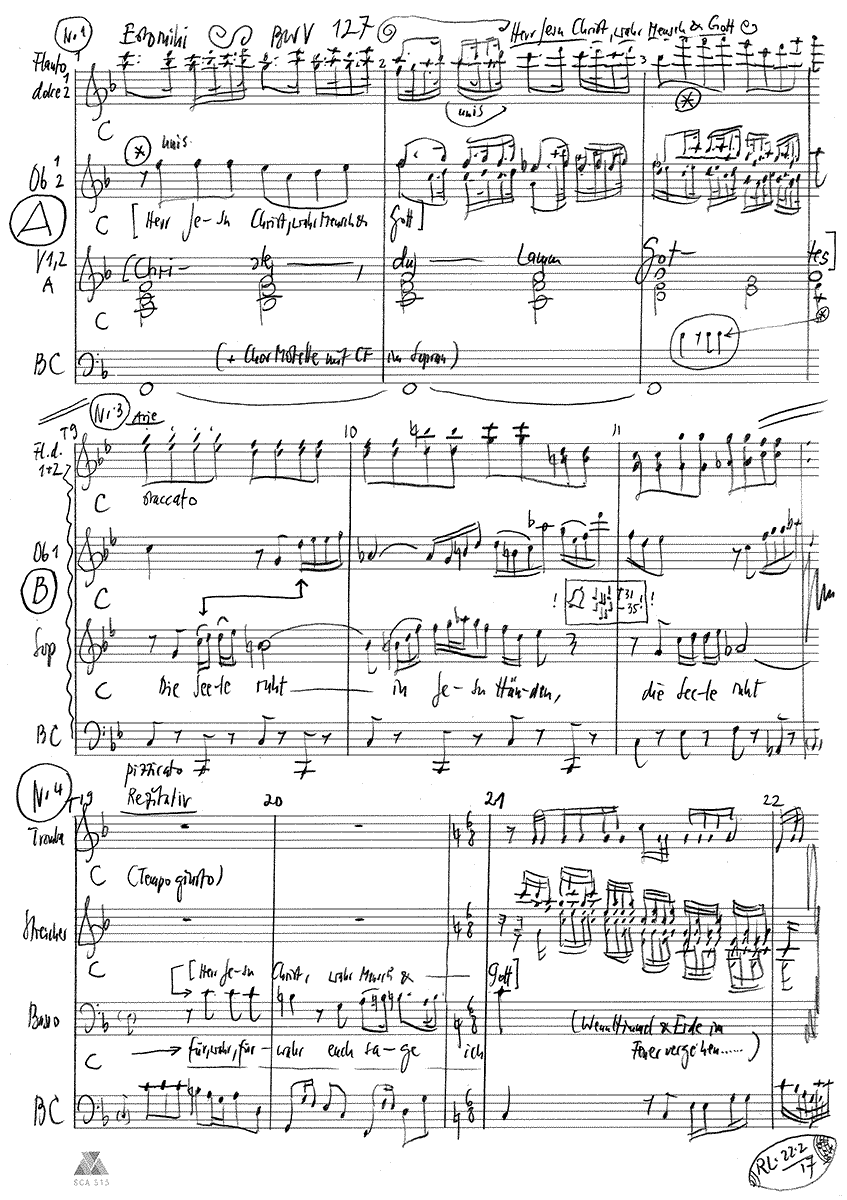
The introductory chorus is a complex structure made up of variable components, which, in typical Bach style, alternate among the instrumental groups of the ensemble. The movement opens with long continuo notes overarched by a descending dotted figure for recorders that is inspired by the transience expressed in the text, and by an oboe figure of piercing quavers that signals the impending Passion of Christ in the church year, which explains why this movement was included in the work “Wer ist der, so von Edom kömmt”, a pasticcio Passion composition assembled by Bach’s circle of students around 1750. This theme, derived from the chorale, is later taken up in the pre-imitations in the lower vocal parts, while the suffering of the Saviour is immediately present in the first entry of the string section, which sounds the first phrase of the chorale “Christe, du Lamm Gottes”. Through Bach’s deft motivic handling, this “secondary chorale” is then presented by the oboes before the emphasis shifts once again with the entry of the choir. While the lower choir voices present each line of the chorale with some chromatic shading, the soprano cantus firmus is doubled by a trumpet that embodies the severity of the Last Days. The high level of freedom that Bach allows himself in the treatment of the chorale is thrown into stark relief by the bold repetition of the last line “For all my sins be merciful”: the soprano voice breaks its ties to the cantus firmus, thus transforming the early church hymn into a personal plea that imbues the following movements with extraordinary energy.
In the tenor recitative, the notion of the healing death-sweat of the crucified Christ is transferred to mortal humans – because Jesus accepted his own suffering with forbearance, he will stand by humans in their last hour. The strong imagery of the music, beginning already with the setting of “sighing”, becomes steady and trusting as soon as the name “Jesus” is mentioned, while an intimate bass tremolo at the end of the movement evokes the peace to be found in death.
This thought is then taken up in the soprano aria, whose reflective words of noble sorrow are embedded in the aura of a soulful letting go, for which Bach allows endless time: the oboe, with a tender but world-weary cantilena, transcends the constant, drop-like staccato notes of the recorders and the gentle pizzicato quavers of the continuo. While the recorders, once again representative of transience, are first allowed to sing out more freely towards the end of the A section, the strings enter in the middle section with a pizzicato figure precisely on the words “deathly tolling”. Like a compassionate pastor, Bach accompanies his listeners along every station of their path in life – where the text speaks with conventional disdain of death (“I am at dying undismayed”), the music culminates in a moment of confusion before being resolved by an unaccompanied oboe figure – the voice of the Holy Spirit – that leads to a new sense of security and trust in the resurrection.
Accompanied by an orchestral cacophony and merciless trumpet fanfares, the bass recitative unfurls a drastic vision that evokes terror of the Last Judgement, while the arioso sections, marked a tempo giusto, speak of the eternal promise to the righteous. The motive of this trusting, arioso section is derived from “Herr Jesu Christ”, the hymn of the first movement, thus creating a skilful internal link within the cantata, but also distinguishing the hymn – a constitutive element of the annual cycle – as flowing directly from God’s word. While this powerful scene of faithful trust in the face of the trials of the Last Days cogently underscores the role of Christ as a messenger of reconciliation, it also seems to have particularly inspired Bach, who – on the last Sunday before the break from figural music during Lent – once again pulled out all the artistic stops.
The movement is followed by the closing chorale, which functions as a powerful, hymnal summary; the melody is set for soprano voice and doubled in a higher register by the silvery timbre of the recorders. With the return of the chorale, Bach echoes the sensitive interpretation of the opening movement, which is particularly effective in accentuating the poignant harmonisation of the last line “Until we rest in blessed sleep”.
Libretto
1. Choral
Herr Jesu Christ, wahr’ Mensch und Gott,
der du littst Marter, Angst und Spott,
für mich am Kreuz auch endlich starbst
und mir deins Vaters Huld erwarbst,
ich bitt durchs bittre Leiden dein,
du wollst mir Sünder gnädig sein.
2. Rezitativ (Tenor)
Wenn alles sich zur letzten Zeit entsetzet,
und wenn ein kalter Todesschweiß
die schon erstarrten Glieder netzet,
wenn meine Zunge nichts als nur
durch Seufzer spricht
und dieses Herze bricht:
genung, daß da der Glaube weiß,
daß Jesus bei mir steht,
der mit Geduld zu seinem Leiden geht
und diesen schweren Weg auch mich geleitet
und mir die Ruhe zubereitet.
3. Arie (Sopran)
Die Seele ruht in Jesu Händen,
wenn Erde diesen Leib bedeckt.
Ach ruft mich bald, ihr Sterbeglocken,
ich bin zum Sterben unerschrocken,
weil mich mein Jesus wieder weckt.
4. Rezitativ und Arie (Bass)
Wenn einstens die Posaunen schallen,
und wenn der Bau der Welt
nebst denen Himmelsfesten
zerschmettert wird zerfallen,
so denke mein, mein Gott, im besten;
wenn sich dein Knecht einst vors Gerichte stellt,
da die Gedanken sich verklagen,
so wollest du allein,
o Jesu, mein Fürsprecher sein
und meiner Seele tröstlich sagen:
Fürwahr, fürwahr, euch sage ich:
Wenn Himmel und Erde im Feuer vergehen,
so soll doch ein Gläubiger ewig bestehen.
Er wird nicht kommen ins Gericht
und den Tod ewig schmecken nicht.
Nur halte dich,
mein Kind, an mich,
nur halte dich an mich:
Ich breche mit starker und helfender Hand
des Todes gewaltig geschlossenes Band.
Fürwahr, fürwahr, euch sage ich:
Wenn Himmel und Erde im Feuer vergehen,
so soll doch ein Gläubiger ewig bestehen.
5. Choral
bis unser Stündlein kömmt herbei,
auch unser Glaub stets wacker sei,
dein’m Wort zu trauen festiglich,
bis wir einschlafen seliglich.
All libretti sourced from Neue Bach-Ausgabe. Johann Sebastian Bach. Neue Ausgabe sämtlicher Werke, published by the Johann-Sebastian-Bach-Institut Göttingen and the Bach-Archiv Leipzig, Series I (Cantatas), vol. 1–41, Kassel and Leipzig, 1954–2000.
All in-depth analyses by Anselm Hartinger (English translations/editing by Alice Noger-Gradon/Mary Carozza) based on the following sources: Hans-Joachim Schulze, Die Bach-Kantaten. Einführungen zu sämtlichen Kantaten Johann Sebastian Bachs, Leipzig, 2nd edition, 2007; Alfred Dürr, Johann Sebastian Bach. Die Kantaten, Kassel, 9th edition, 2009, and Martin Petzoldt, Bach-Kommentar. Die geistlichen Kantaten, Stuttgart, vol. 1, 2nd edition, 2005 and vol. 2, 1st edition, 2007.