



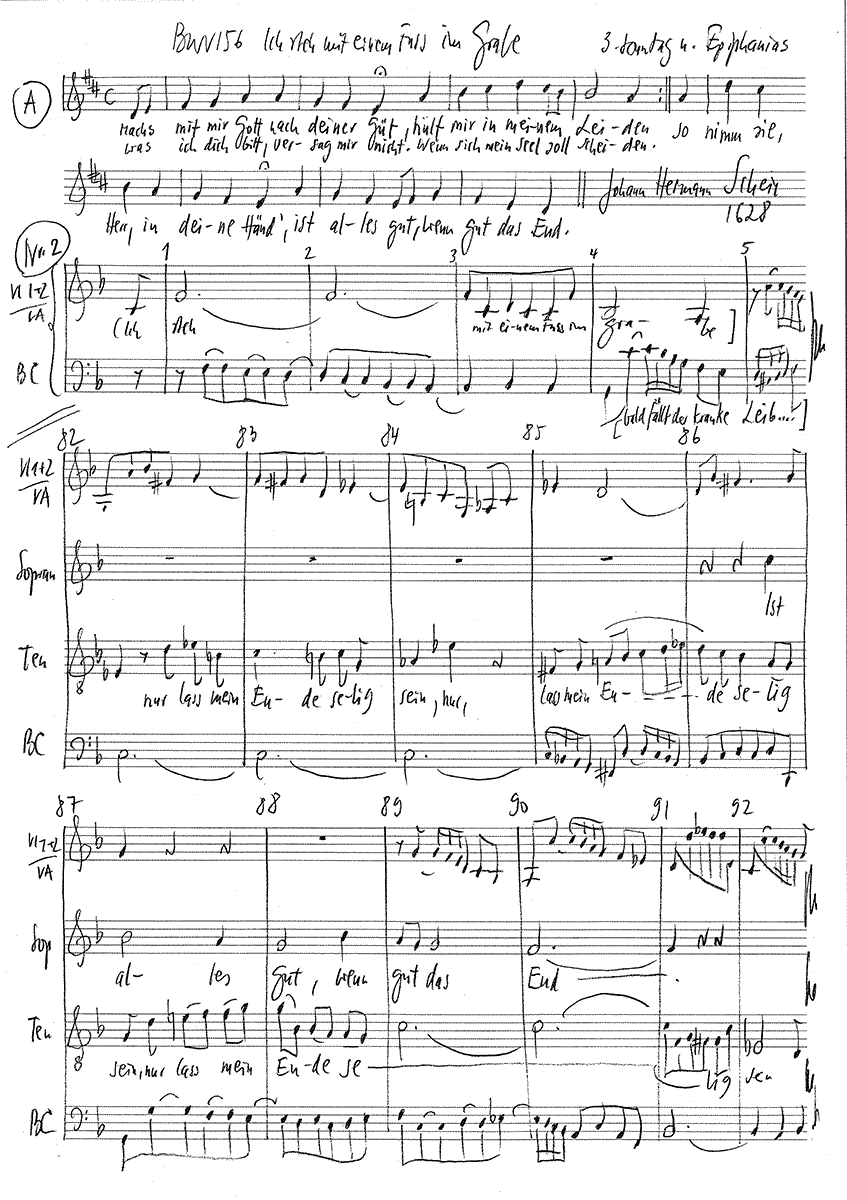

Ich steh mit einem Fuß im Grabe
BWV 156 // For the Third Sunday after Epiphany
(I stand with one foot in the grave now) for soprano, alto, tenor and bass, oboe, strings and continuo.
Cantata BWV 156 is distinguished by its poignant language and intimate scoring, and thus resembles the compositions of Bach’s Weimar period. But in fact, it belongs to the works that Bach, at least in part, composed for a text cycle by Picander, Bach’s “house poet” in Leipzig, and that was most likely first performed on 23 January 1729. The original parts are lost, and even the oldest surviving copy of the score probably did not find its way back to Leipzig until 1756 when Johann Friedrich Doles took up the position of Thomascantor. Nevertheless, there are an astounding number of copies remaining from around 1830, indicating that this cantata particularly appealed to Bach’s admirers from the romantic period.

Place of composition in the church year
Pericopes for Sunday
Pericopes are the biblical readings for each Sunday and feast day of the liturgical year, for which J. S. Bach composed cantatas. More information on pericopes. Further information on lectionaries.
Herr, wie lange willst du mein so gar vergessen? Wie lange verbirgst du dein Antlitz vor mir? Wie lange soll ich sorgen in meiner Seele und mich ängsten in meinem Herzen täglich? Wie lange soll sich mein Feind über mich erheben? – Ich hoffe aber darauf, dass du so gnädig bist; mein Herz freut sich, dass du so gerne hilfst. Ich will dem Herrn singen, dass er so wohl an mir tut.
Haltet euch nicht selbst für klug. Vergeltet niemand Böses mit Bösem. Fleissiget euch der Ehrbarkeit gegen jedermann. Ist es möglich, soviel an euch ist, so habt mit allen Menschen Frieden. Rächet euch selber nicht, meine Liebsten, sondern gebet Raum dem Zorn [Gottes]; denn es steht geschrieben: «‹Die Rache ist mein; ich will vergelten›, spricht der Herr.» So nun deinen Feind hungert, so speise ihn; dürstet ihn, so tränke ihn. Wenn du das tust, so wirst du feurige Kohlen auf sein Haupt sammeln. Lass dich nicht das Böse überwinden, sondern überwinde das Böse mit Gutem.
Da er aber vom Berge herabging, folgte ihm viel Volks nach. Und siehe, ein Aussätziger kam und betete ihn an und sprach: «Herr, so du willst, kannst du mich wohl reinigen.» Und Jesus streckte seine Hand aus, rührte ihn an und sprach: «Ich will’s; sei gereinigt!» Und alsbald ward er von seinem Aussatz rein. Und Jesus sprach zu ihm: «Siehe zu, sage es niemand; sondern gehe hin und zeige dich dem Priester und opfere die Gabe, die Mose befohlen hat, zum Zeugnis über sie.» Da aber Jesus einging zu Kapernaum, trat ein Hauptmann zu ihm, der bat ihn und sprach: «Herr, mein Knecht liegt zu Hause und ist gichtbrüchig und hat grosse Qual.» Jesus sprach zu ihm: «Ich will kommen und ihn gesund machen.» Der Hauptmann antwortete und sprach: «Herr, ich bin nicht wert, dass du unter mein Dach gehest; sondern sprich nur ein Wort, so wird mein Knecht gesund. Denn ich bin ein Mensch, der Obrigkeit untertan, und habe unter mir Kriegsknechte; und wenn ich sage zu einem: Gehe hin!, so geht er; und zum andern: Komm her!, so kommt er; und zu meinem Knecht: Tu das!, so tut er’s.» Da Jesus das hörte, verwunderte er sich und sprach zu denen, die ihm nachfolgten: «Wahrlich, ich sage euch: Solchen Glauben habe ich in Israel nicht gefunden! Aber ich sage euch: Viele werden kommen vom Morgen und vom Abend und mit Abraham und Isaak und Jakob im Himmelreich sitzen; aber die Kinder des Reichs werden ausgestossen in die Finsternis hinaus; da wird sein Heulen und Zähneklappern.» Und Jesus sprach zu dem Hauptmann: «Gehe hin; dir geschehe, wie du geglaubt hast.» Und sein Knecht ward gesund zu derselben Stunde.
Would you like to enjoy our videos ad-free? Subscribe to YouTube Premium now...

By loading the video, you agree to YouTube's privacy policy.
Learn more
Workshop
By loading the video, you agree to YouTube's privacy policy.
Learn more
Reflective lecture
By loading the video, you agree to YouTube's privacy policy.
Learn more
Publikationen zum Werk im Shop


Orchestra
Conductor
Rudolf Lutz
Violin
Renate Steinmann, Plamena Nikitassova
Viola
Susanna Hefti
Violoncello
Martin Zeller
Violone
Iris Finkbeiner
Oboe d’amore
Stefanie Haegele
Bassoon
Susann Landert
Organ
Rudolf Lutz
Musical director & conductor
Rudolf Lutz
Workshop
Participants
Karl Graf, Rudolf Lutz
Reflective lecture
Speaker
Gottfried Schatz
Recording & editing
Recording date
01/22/2010
Recording location
Trogen
Sound engineer
Stefan Ritzenthaler
Director
Meinrad Keel
Production manager
Johannes Widmer
Production
GALLUS MEDIA AG, Switzerland
Producer
J.S. Bach Foundation of St. Gallen, Switzerland
Librettist
Text No. 1–5
Christian Friedrich Henrici,
known as Picander, 1728
Text No. 1 (Zwischenzeilen)
Johann Hermann Schein, 1628
Text No. 6
Kaspar Bienemann, 1582
First performance
Third Sunday after Epiphany,
23 January 1729
In-depth analysis
The opening sinfonia, which Bach later reused as the middle movement of his Harpsichord Concerto in F Minor BWV 1056, is probably based on an older composition from Bach’s Weimar or Cöthen period. More famous than the cantata itself, the sinfonia sets a dreamy oboe cantilena over a simple accompaniment of gentle bass notes and off-beat strings, thus embodying a contemplative faith that could also be understood as a peaceful “Méditation sur ma mort future” due to the libretto’s reflection on death. Although the adagio movement is only 20 bars long, it is complete and well-rounded in ternary form, concluding with a mini-coda that transitions to an open finish on the dominant.
The tenor aria with soprano chorale sustains the gentle tone of the opening movement; set over descending continuo sighs, the unison line for violins and viola, derived from the head motive of “I stand”, sounds almost as if played with mutes. Nevertheless, considerable contrapuntal finesse lies hidden behind the trusting mood conveyed. In particular, Bach’s interpolation of a soprano cantus firmus – the hymn on death “Deal with me, God, of thy good will” – displays great skill: while the early insertion of the first chorale line seems almost premature, the final comfort found in the hour of death (“For all is good, if good the end”) is first granted with dramatacised delay. Indeed, the aria provides an apt example for the significant contrast between the baroque Ars moriendi and modern perceptions of death. A line such as “I stand with one foot in the grave now, soon shall my ailing corpse fall in,” sounds gruesome today, but in view of the “prepared house” in Bach’s theologically rooted interpretation, it could be seen in his times as a comforting promise. Nonetheless, Bach keenly understood human nature and did not obscure mortal fear of the hour of death and eternal damnation (“Just let my end with blessing come!”) – the collective support of the venerable chorale is precisely what is needed.
The bass recitative then presents an earnest meditation in which all rests in the hands of a loving God and acknowledgement of personal sin is put forth as the condition for receiving mercy (“Let thy dear kindness greater be than justice rightly bids”). Like the two halves of an hour-glass, the arioso closing sets earthly life and imminent heavenly joy in a temporal relationship (“The longer here, the later there”), an idea that the general bass aptly underscores with a hesitant ascending figure.
The alto aria “Lord, what thou wilt shall be my pleasure” again provides a clear reference to the Gospel of the third Sunday and its theme of submission to God’s will as presented in the stories of healing the sick in Matthew 8, in that Bach employ’s the key phrase “Lord, what thou wilt” as a musical device. The movement, set in the comforting key of B-flat major, features a fugal setting for oboe, violin and a light-footed continuo in which the lines of the alto soloist are thematically inserted. The expansive vocal lines that close the A section reflect not only the work’s interpretation of joy, suffering, death and supplication, but also Bach’s efforts to make himself clear to his audience.
In the second bass recitative the soloist resumes his observations, expressing a desire for bodily health and, more importantly, health and integrity of the soul. In Bach’s hands, the verse from Psalm 73 “And if my soul and body fail, yet thou art, God, my strength, the portion of my heart!” – a frequently quoted line in baroque compositions on death – is lent a sensitive and refreshing musical language.
The cantata closes with a chorale verse set to a masterfully succinct text by Kaspar Bienemann. Despite its compact form, the exquisitely harmonised four-part setting effectively highlights key words through expressive shading (“dying”) and half cadences (“let me forbear”). In this recording, the noble timbre of the accompanying instruments comes to the fore thanks to the small vocal ensemble and charismatic organ interludes.
Libretto
1. Sinfonia
2. Arie (Tenor) und Choral (Sopran)
Ich steh mit einem Fuss im Grabe,
Mach’s mit mir, Gott, nach deiner Güt,
bald fällt der kranke Leib hinein,
hülf mir in meinen Leiden,
Komm, lieber Gott, komm wenn dir’s gefällt,
was ich dich bitt, versag mir nicht.
Ich habe schon mein Haus bestellt,
Wenn sich mein Seel soll scheiden,
so nimm sie, Herr, in deine Händ.
Komm, liebster Gott, komm wenn dir’s gefällt,
nur laß mein Ende selig sein!
Ist alles gut, wenn gut das End.
3. Rezitativ (Bass)
Mein Angst und Not,
mein Leben und mein Tod
steht, liebster Gott, in deinen Händen;
so wirst du auch auf mich
dein gnädig Auge wenden.
Willst du mich meiner Sünden wegen
ins Krankenbette legen,
mein Gott, so bitt ich dich,
laß deine Güte größer sein als die Gerechtigkeit!
Doch hast du mich darzu versehn,
daß mich mein Leiden soll verzehren,
ich bin bereit,
dein Wille soll an mir geschehn,
verschone nicht und fahre fort,
laß meine Not nicht lange währen;
je länger hier, je später dort!
4. Arie (Alt)
Herr, was du willt, soll mir gefallen,
weil doch dein Rat am besten gilt.
In der Freude,
in dem Leide,
im Sterben, in Bitten und in Flehn
laß mir allemal geschehn,
Herr, wie du willt.
5. Rezitativ (Bass)
Und willst du, daß ich nicht soll kranken,
so werd ich dir von Herzen danken.
Doch aber gib mir auch dabei,
daß auch in meinem frischen Leibe
die Seele sonder Krankheit sei
und allezeit gesund verbleibe.
Nimm sie durch Geist und Wort in acht,
denn dieses ist mein Heil,
und wenn mir Leib und Seel verschmacht’,
so bist du, Gott, mein Trost
und meines Herzens Teil.
6. Choral
Herr, wie du willt, so schick’s mit mir
im Leben und im Sterben,
allein zu dir steht mein Begier,
Herr, laß mich nicht verderben!
Erhalt mich nur in deiner Huld,
sonst, wie du willt, gib mir Geduld;
Dein Will der ist der beste.
All libretti sourced from Neue Bach-Ausgabe. Johann Sebastian Bach. Neue Ausgabe sämtlicher Werke, published by the Johann-Sebastian-Bach-Institut Göttingen and the Bach-Archiv Leipzig, Series I (Cantatas), vol. 1–41, Kassel and Leipzig, 1954–2000.
All in-depth analyses by Anselm Hartinger (English translations/editing by Alice Noger-Gradon/Mary Carozza) based on the following sources: Hans-Joachim Schulze, Die Bach-Kantaten. Einführungen zu sämtlichen Kantaten Johann Sebastian Bachs, Leipzig, 2nd edition, 2007; Alfred Dürr, Johann Sebastian Bach. Die Kantaten, Kassel, 9th edition, 2009, and Martin Petzoldt, Bach-Kommentar. Die geistlichen Kantaten, Stuttgart, vol. 1, 2nd edition, 2005 and vol. 2, 1st edition, 2007.