







Gloria in excelsis Deo
BWV 191 // For Christmas Day
(Glory be to God on high) for soprano, tenor, vocal ensemble, trumpets I–III, timpani, flute I+II, oboe I+II, bassoon, strings and continuo.
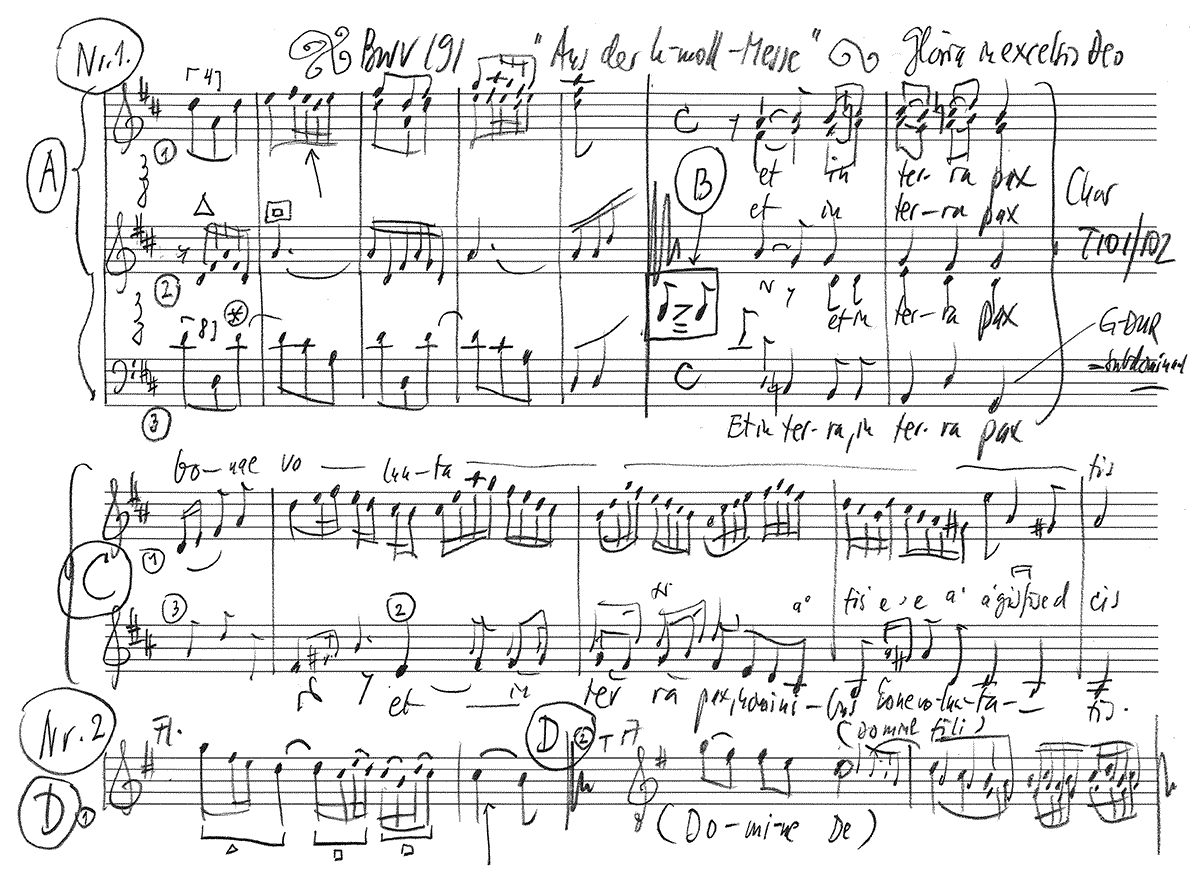
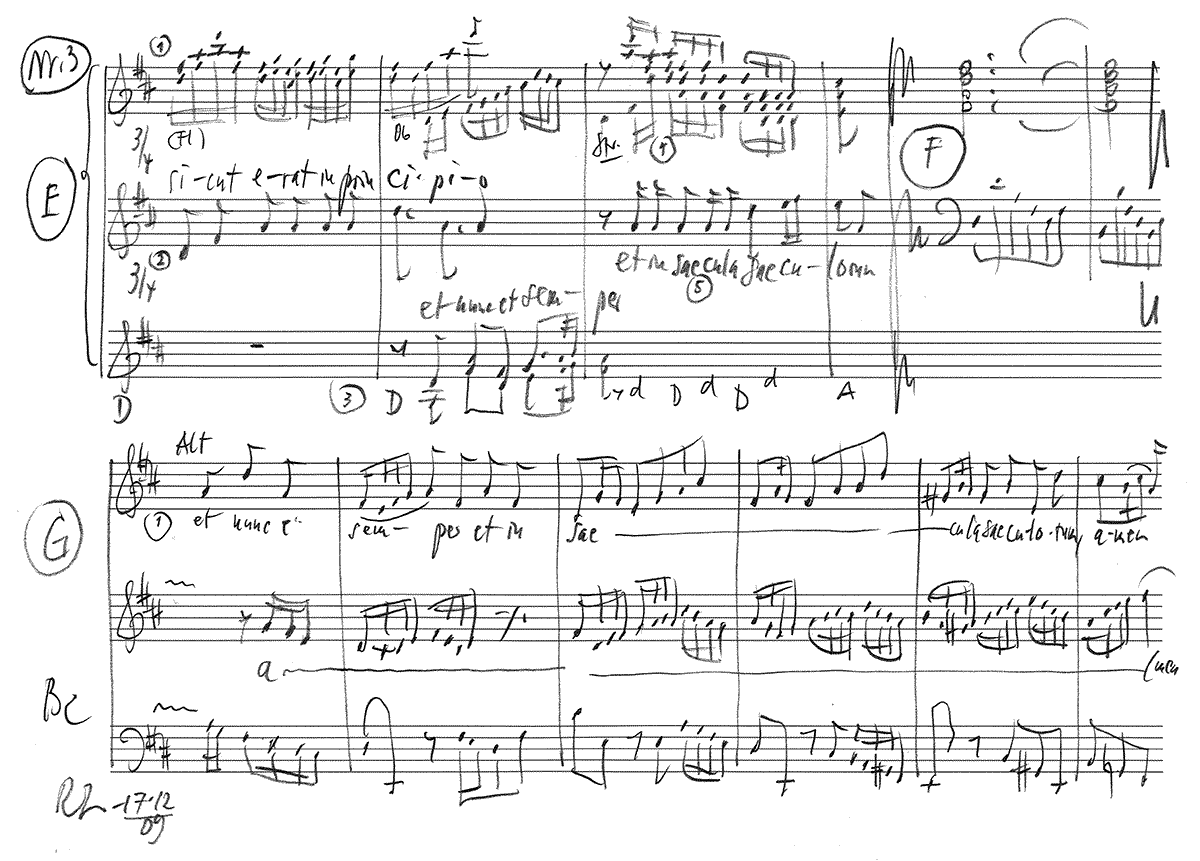
Bach’s Mass in B Minor belongs to his most famous works, yet the history of its composition remains beset with questions, mostly surrounding its puzzling revision and completion in the late 1740s. What is certain, however, is that the Kyrie and Gloria movements were written already in 1733 and pres-ented as a composition dedicated to the new Prince-elector Friedrich August II in Dresden as part of Bach’s efforts to attain the title of Kapellmeister. Notably, these works are themselves partly reconstructions of older compositions that were revised and amended to suit the Latin text of the Mass and their new purpose – a pragmatic parody approach that Bach also applied to the Christmas music “Gloria in excelsis Deo” (BWV 191). Although only one copy of this work survives, it is in Bach’s hand. Preserved today in the Berlin State Library, the autograph score is entitled “J.J. Festo Nativitatis: Xsti. Gloria in excelsis Deo. à 5 Voci. 3 Trombe Tymp. 2 Trav. 2 Hautb. 2 Violini Viola e Cont. di J. S. Bach”. Its three movements are entirely based on drafts for the first version of the B Minor Mass planned for Dresden.
Place of composition in the church year
Pericopes for Sunday
Pericopes are the biblical readings for each Sunday and feast day of the liturgical year, for which J. S. Bach composed cantatas. More information on pericopes. Further information on lectionaries.
Das ist ein köstlich Ding, dem Herrn danken und lobsingen deinem Namen, du Höchster, des Morgens deine Gnade und des Nachts deine Gnade verkündigen auf den zehn Saiten und Psalter mit Spielen auf der Harfe.
Denn es ist erschienen die heilsame Gnade Gottes allen Menschen und züchtigt uns, dass wir sollen verleugnen das ungöttliche Wesen und die weltlichen Lüste und züchtig, gerecht und gottselig leben in dieser Welt und warten auf die selige Hoffnung und Erscheinung der Herrlichkeit des grossen Gottes und unseres Heilandes, Jesu Christi, der sich selbst für uns gegeben hat, auf dass er uns erlösete von aller Ungerechtigkeit und reinigte sich selbst ein Volk zum Eigentum, das fleissig wäre zu guten Werken.
Es begab sich aber zu der Zeit, dass ein Gebot von dem Kaiser Augustus ausging, dass alle Welt geschätzt würde. Und diese Schätzung war die allererste und geschah zu der Zeit, da Cyrenius Landpfleger in Syrien war. Und jedermann ging, dass er sich schätzen liesse, ein jeglicher in seine Stadt. Da machte sich auf auch Joseph aus Galiläa, aus der Stadt Nazareth, in das jüdische Land zur Stadt Davids, die da heisst Bethlehem, darum dass er von dem Hause und Geschlechte Davids war, auf dass er sich schätzen liesse mit Maria, seinem vertrauten Weibe, die war schwanger. Und als sie daselbst waren, kam die Zeit, dass sie gebären sollte. Und sie gebar ihren ersten Sohn und wickelte ihn in Windeln und legte ihn in eine Krippe; denn sie hatten sonst keinen Raum in der Herberge. Und es waren Hirten in derselben Gegend auf dem Felde bei den Hürden, die hüteten des Nachts ihre Herde. Und siehe, des Herrn Engel trat zu ihnen, und die Klarheit des Herrn leuchtete über sie; und sie fürchteten sich sehr. Und der Engel sprach zu ihnen: «Fürchtet euch nicht! Siehe, ich verkündige euch grosse Freude, die allem Volk widerfahren wird; denn euch ist heute der Heiland geboren, welcher ist Christus, der Herr, in der Stadt Davids. Und das habt zum Zeichen: Ihr werdet finden das Kind in Windeln gewickelt und in einer Krippe liegen.» Und alsbald war da bei dem Engel die Menge der himmlischen Heerscharen, die lobten Gott und sprachen: «Ehre sei Gott in der Höhe und Friede auf Erden und den Menschen ein Wohlgefallen.»
Would you like to enjoy our videos ad-free? Subscribe to YouTube Premium now...
You are currently viewing a placeholder content from Default. To access the actual content, click the button below. Please note that doing so will share data with third-party providers.
More InformationWorkshop
You are currently viewing a placeholder content from Default. To access the actual content, click the button below. Please note that doing so will share data with third-party providers.
More InformationReflective lecture
You are currently viewing a placeholder content from Default. To access the actual content, click the button below. Please note that doing so will share data with third-party providers.
More InformationBonus material
You are currently viewing a placeholder content from Default. To access the actual content, click the button below. Please note that doing so will share data with third-party providers.
More InformationPublikationen zum Werk im Shop


Choir
Soprano
Mirjam Berli, Susanne Frei, Leonie Gloor, Guro Hjemli, Mami Irisawa, Damaris Nussbaumer, Jennifer Rudin, Noëmi Tran Rediger
Alto
Alexandra Rawohl, Antonia Frey, Olivia Heiniger, Lea Scherer
Tenor
Marcel Fässer, Nicolas Savoy, Walter Siegel
Bass
Fabrice Hayoz, Philippe Rayot, William Wood
Orchestra
Conductor
Rudolf Lutz
Violin
Renate Steinmann, Anaïs Chen, Sylvia Gmür, Sabine Hochstrasser, Martin Korrodi, Livia Wiersich
Viola
Susanna Hefti, Martina Bischof
Violoncello
Claire Pottinger
Violone
Iris Finkbeiner
Oboe
Luise Baumgartl, Thomas Meraner
Bassoon
Susann Landert
Tromba da tirarsi
Patrick Henrichs, Peter Hasel, Klaus Pfeiffer
Transverse flute
Claire Genewein, Maria Mittermayr
Timpani
Martin Homann
Organ
Norbert Zeilberger
Musical director & conductor
Rudolf Lutz
Workshop
Participants
Karl Graf, Rudolf Lutz
Reflective lecture
Speaker
Dr. Phil. Notker Wolf OSB
Recording & editing
Recording date
12/18/2009
Recording location
Trogen
Sound engineer
Stefan Ritzenthaler
Director
Meinrad Keel
Production manager
Johannes Widmer
Production
GALLUS MEDIA AG, Switzerland
Producer
J.S. Bach Foundation of St. Gallen, Switzerland
In-depth analysis
The text and music of the introductory chorus “Gloria in excelsis” is reused with only minimal amendments, while the soprano and tenor duet “Gloria patri et filio et Spiritui sancto” as well as the closing chorus “Sicut erat in principio” are clearly reworkings of the “Domine Deus” and “Cum sancto spiritu” movements of the Mass. Aside from its new libretto, the shortening of the duet by 20 bars represents the greatest change in the first movement. In contrast to these minimal alterations, many details in the weighty closing chorus were revised, with the most obvious change for listeners familiar with the B Minor Mass being the extra bar preceding each appearance of the phrase “Sicut erat in principio”. In addition, the flutes and oboes (scored unison in the Mass) are given separate parts, perhaps to lend the work a more festive, Christmas spirit and to provide a more natural transition to the following flute-accompanied duet “Gloria patri”. Aside from its assignation to the First Day of Christmas and the easily recognisable parody source, the remaining details of the composition’s origin remain unknown. It was certainly not planned as a liturgical mass; the note “Post orationem” indicates rather that it was intended as a two-part work framing the sermon, a typical feature of Bach’s church cantatas. Since there are no indications to date that a musical setting of the gospel in Latin took place in a Leipzig city church – a most improbable scenario – the great Bach scholar Alfred Dürr has long suggested that the work was occasioned as a special commission or for a particular event. In this regard, even the briefest of notes by Bach on the autograph would have made the work of generations of later scholars much easier. The date of the work is also unclear and can only be roughly allocated to the last ten years of Bach’s life based on an analysis of the manuscript paper. Of certainty, however, is that it is an enchanting parody on three movements from Bach’s great Mass, and that it is well worthy of more frequent performance.
Libretto
1. Chor
Gloria in excelsis Deo.
Et in terra pax hominibus
bonae voluntatis.
Post orationem
2. Duett (Sopran, Tenor)
Gloria Patri et Filio
et Spiritui sancto.
3. Chor
Sicut erat in principio et nunc et semper
et in saecula saeculorum, amen.
All libretti sourced from Neue Bach-Ausgabe. Johann Sebastian Bach. Neue Ausgabe sämtlicher Werke, published by the Johann-Sebastian-Bach-Institut Göttingen and the Bach-Archiv Leipzig, Series I (Cantatas), vol. 1–41, Kassel and Leipzig, 1954–2000.
All in-depth analyses by Anselm Hartinger (English translations/editing by Alice Noger-Gradon/Mary Carozza) based on the following sources: Hans-Joachim Schulze, Die Bach-Kantaten. Einführungen zu sämtlichen Kantaten Johann Sebastian Bachs, Leipzig, 2nd edition, 2007; Alfred Dürr, Johann Sebastian Bach. Die Kantaten, Kassel, 9th edition, 2009, and Martin Petzoldt, Bach-Kommentar. Die geistlichen Kantaten, Stuttgart, vol. 1, 2nd edition, 2005 and vol. 2, 1st edition, 2007.